50 Years: RCMP Explosive Disposal Units — Leadership and Judgment (Part 3)
For 50 years, the RCMP’s Explosive Disposal Units (EDU) have responded to dangers most Canadians never see. This three-part series explores the people, philosophy, and evolution behind one of policing’s most exacting specializations.
Part 3 of 3explores the leadership, judgment, and quiet confidence that define modern RCMP Explosive Disposal Units through the experiences of those shaping the discipline today and carrying it into its next half-century.
–
For Staff Sergeant Anne Alary, explosives disposal work often narrows to a single moment: when uncertainty tightens and someone has to decide what happens next.
EDU work, she explained, never exists in a vacuum. It intersects with other police units, partner agencies, and overlapping jurisdictions, often under time pressure and incomplete information. In those moments, clarity matters more than speed.
“At some point,” Anne said, “somebody needs to make a decision.”
Long before joining the RCMP in 2003, Anne learned how to perform under pressure as a high-level athlete. She played varsity hockey at the University of Ottawa, went on to compete in the National Women’s Hockey League, and carried that same discipline into policing.

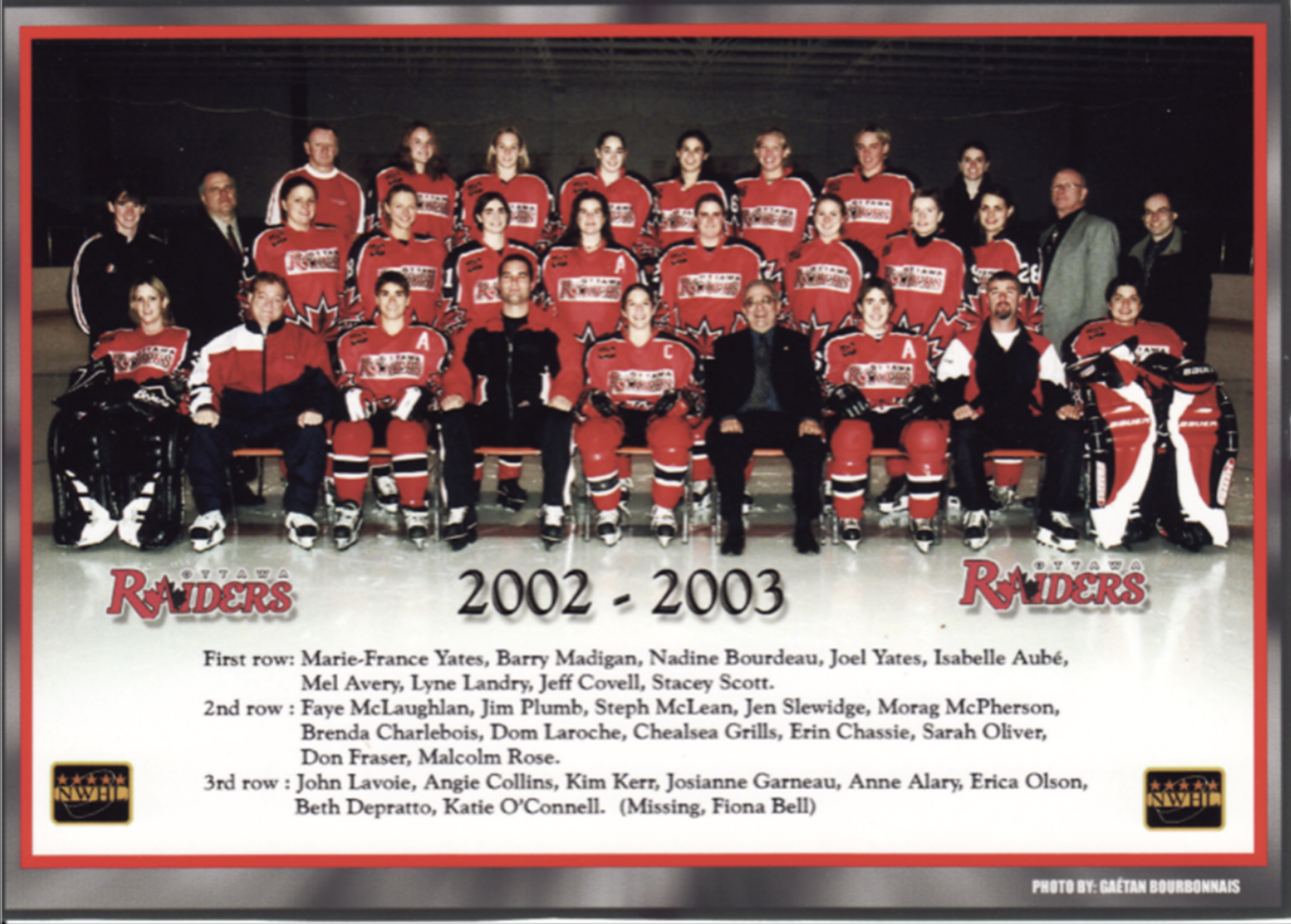
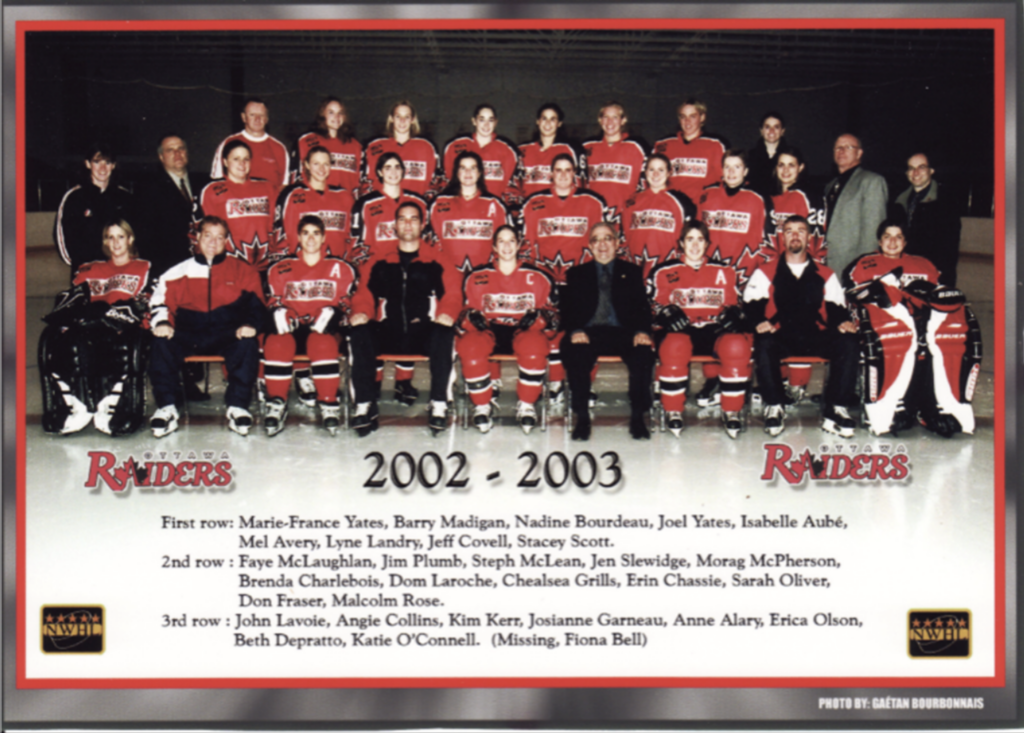
A Team Photo of the Ottawa Riders from 2002. Anne can be seen in the third row, fifth from the left.
After graduating from Depot, Anne took on a wide range of postings that sharpened her skills—from rural policing in Assiniboia, to serving in Pelican Narrows in northern Saskatchewan, to her assignment with the Musical Ride, to providing protective duty on Parliament Hill, and finally to conducting surveillance with Special Operations.
A friend and colleague of Anne’s who worked in Chemical, Biological, Radiological, and Nuclear (CBRN) operations encouraged Anne to explore a career in EDU. Anne had the opportunity to job shadow and realized this specialization fit her like a glove.
“There’s no black and white in EDU,” she said. “The whole job is grey. You change one variable, everything changes. There’s no manual.”
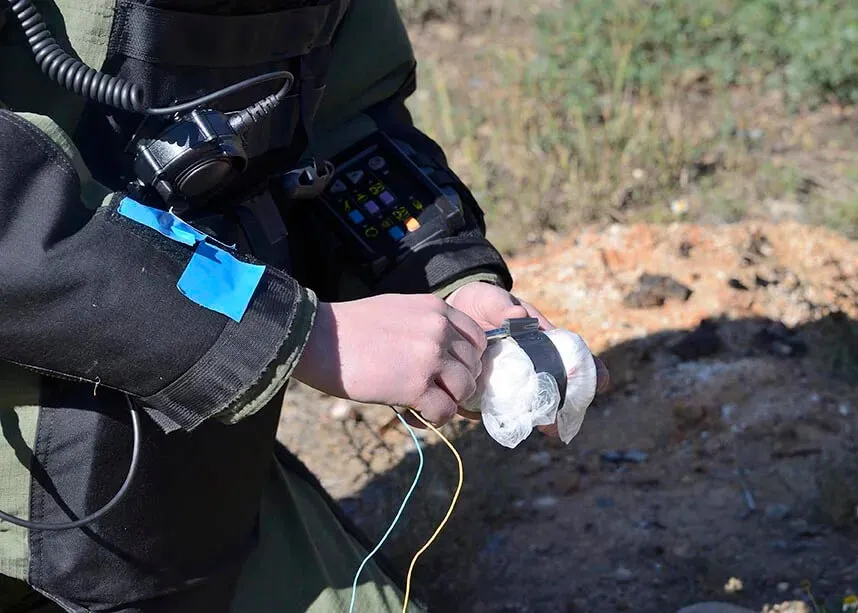
Today, Anne serves as the NCO i/c (Non-Commissioned Officer in Charge) of National Headquarters EDU and the Policy Centre in Ottawa. She is a trained bomb technician and specialized in explosive forced entry, working at the intersection of operations, policy, and national coordination.
“Some days,” she reflected, “it happens like that—and you have to be prepared to ask yourself, ‘What do I do now?’”
That emphasis on preparedness shaped her work as an instructor at the Canadian Police College, where she helped train future bomb technicians, focusing not just on procedures but on the mental discipline required when Members must rely on their judgment alone.
Anne is also one of relatively few women to have served in the RCMP’s Explosive Disposal Unit, a fact she has never positioned as defining. Within EDU, credibility is earned through performance, consistency, and trust. Her authority comes from experience, built over years of making decisions when the stakes were high and the answers were not always clear.
Her ongoing story reflects a quiet confidence not driven by visibility, but by judgment.

The Goal is Control
For Sergeant Peter Vail, explosives disposal is rarely decided at the moment a technician approaches a device. More often, the outcome is shaped well before that—through planning, assessment, and discipline developed over decades of experience.
Before entering municipal policing in New Brunswick in 1994, Peter served in the Canadian Forces Primary Reserve, where he gained early exposure to explosives. That background laid important groundwork, but it was a call several years later that sharpened his focus. In 1997, after responding to an incident involving a pipe bomb and observing the work of an explosives technician, Peter became increasingly drawn to the field.

In 2000, he was selected to attend the Canadian Police College bomb technician program, formally beginning his specialization. When he joined the RCMP in 2005, he continued that work, eventually becoming a key figure in the evolution of explosives disposal in the region.
At the time of this article, Peter has served for 12 years as the J Division Coordinator for the Provincial Explosive Disposal Unit. In that role, he has helped guide modernization efforts while maintaining continuity with the fundamentals passed down by earlier generations of technicians.
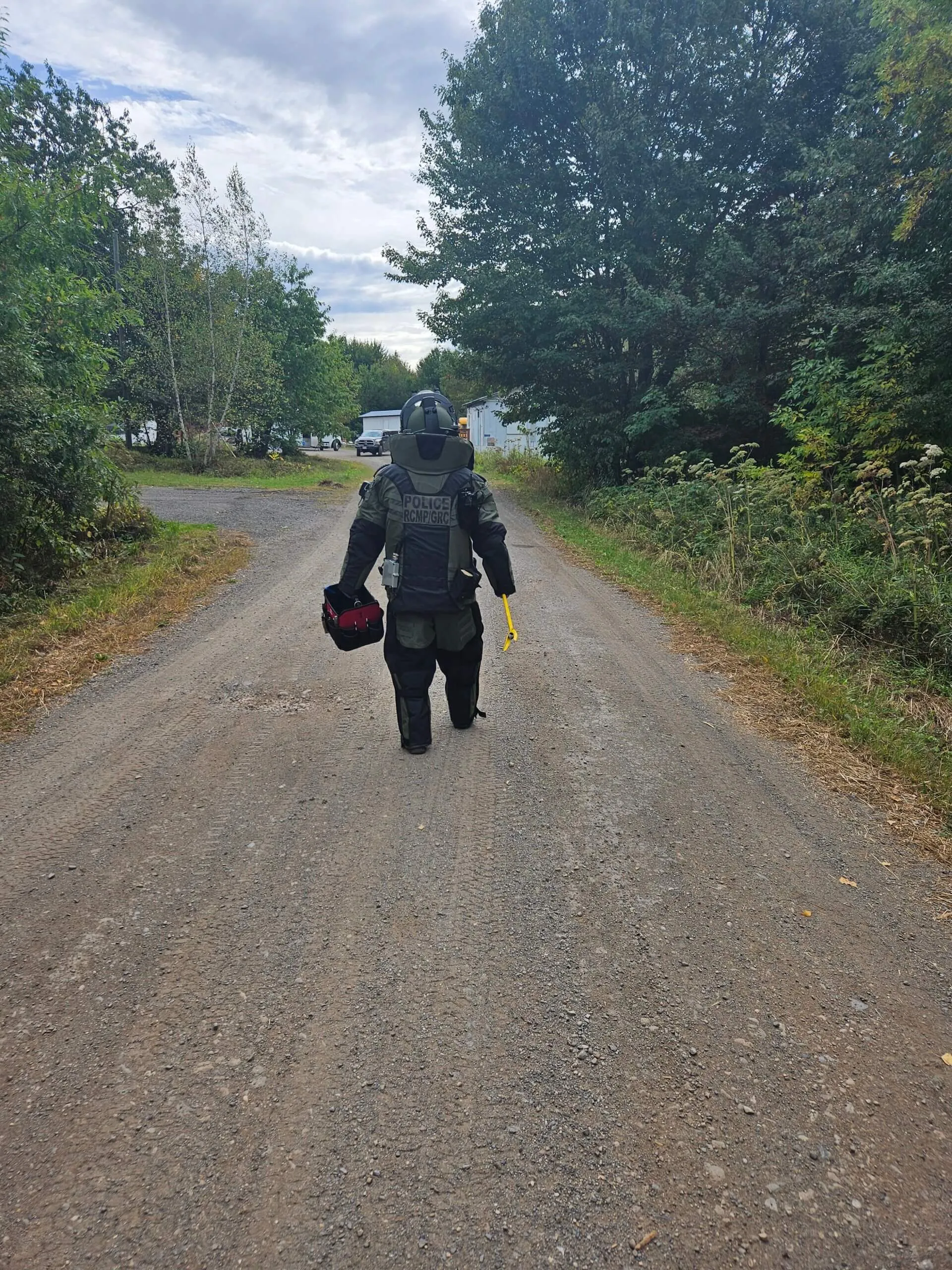
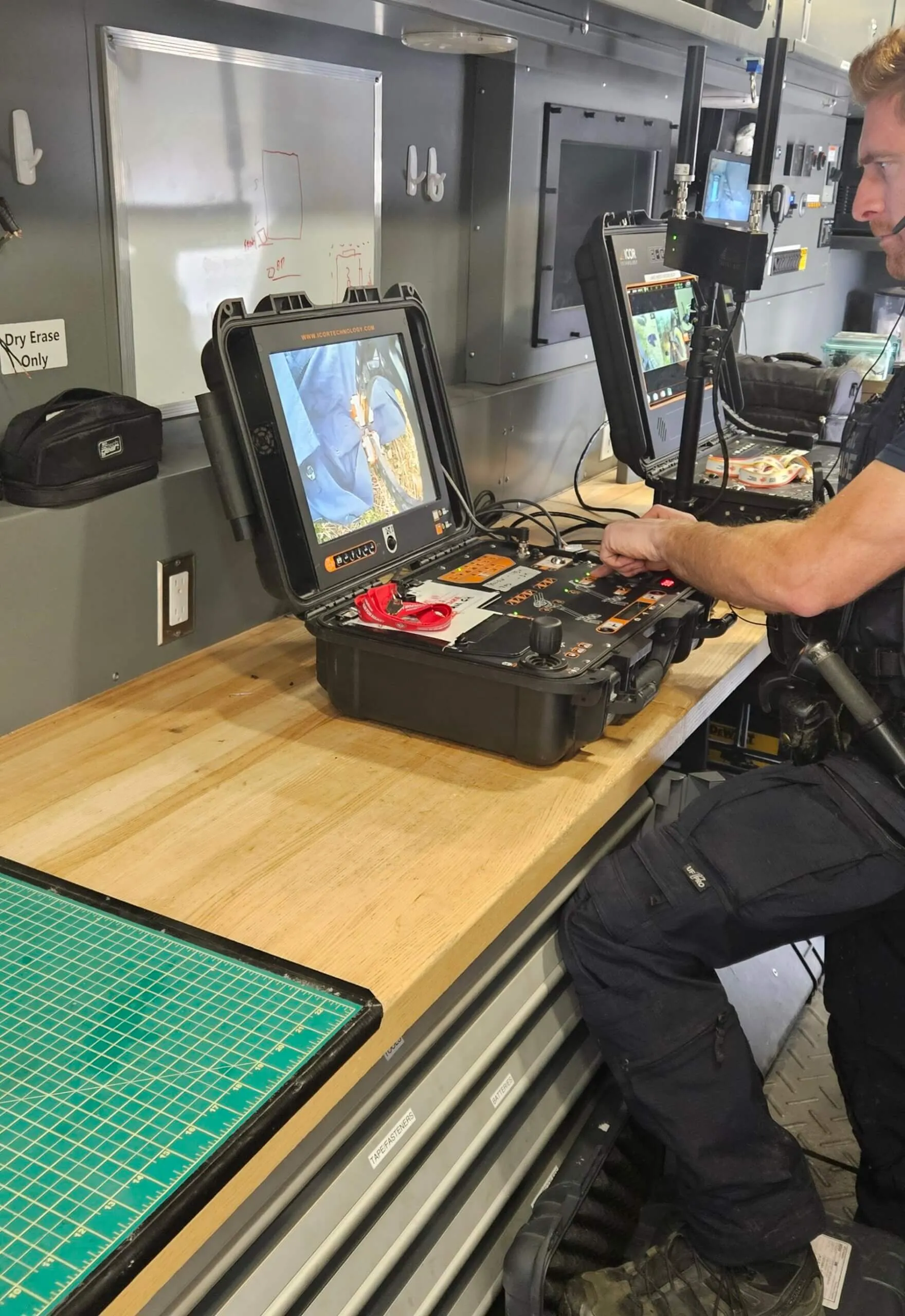
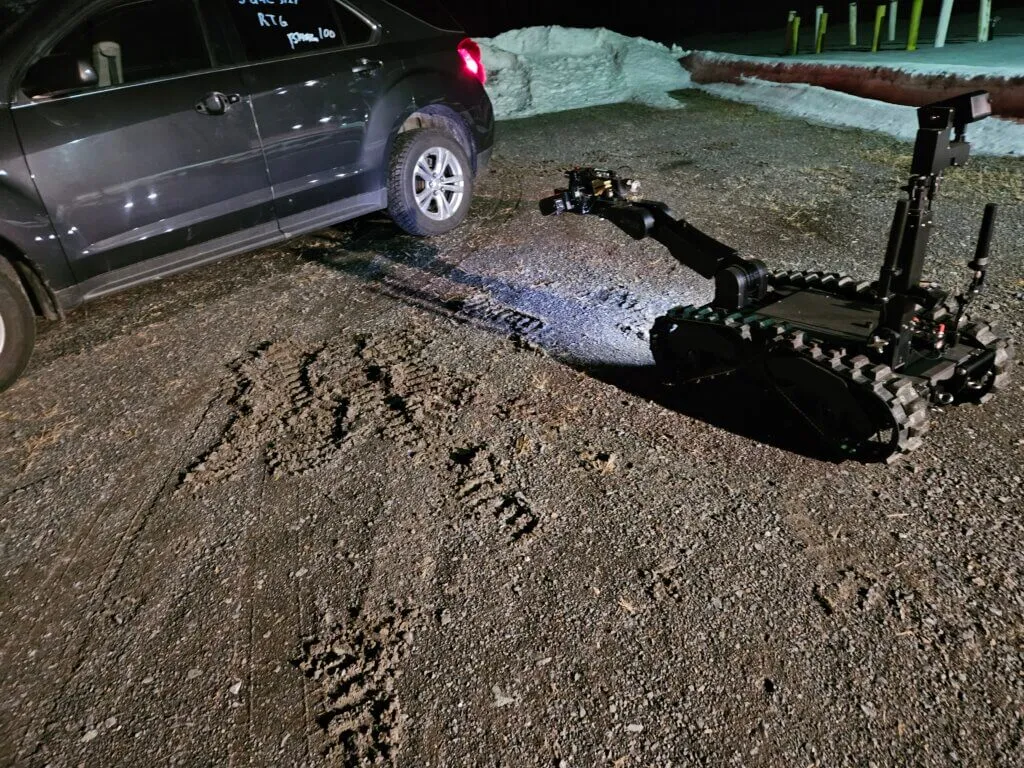
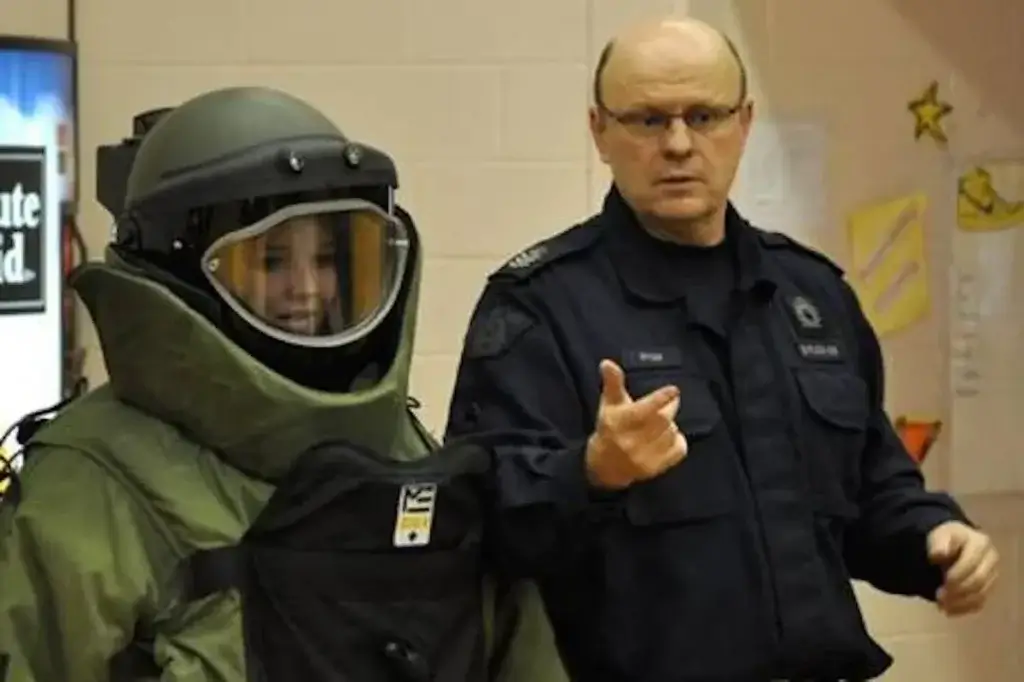
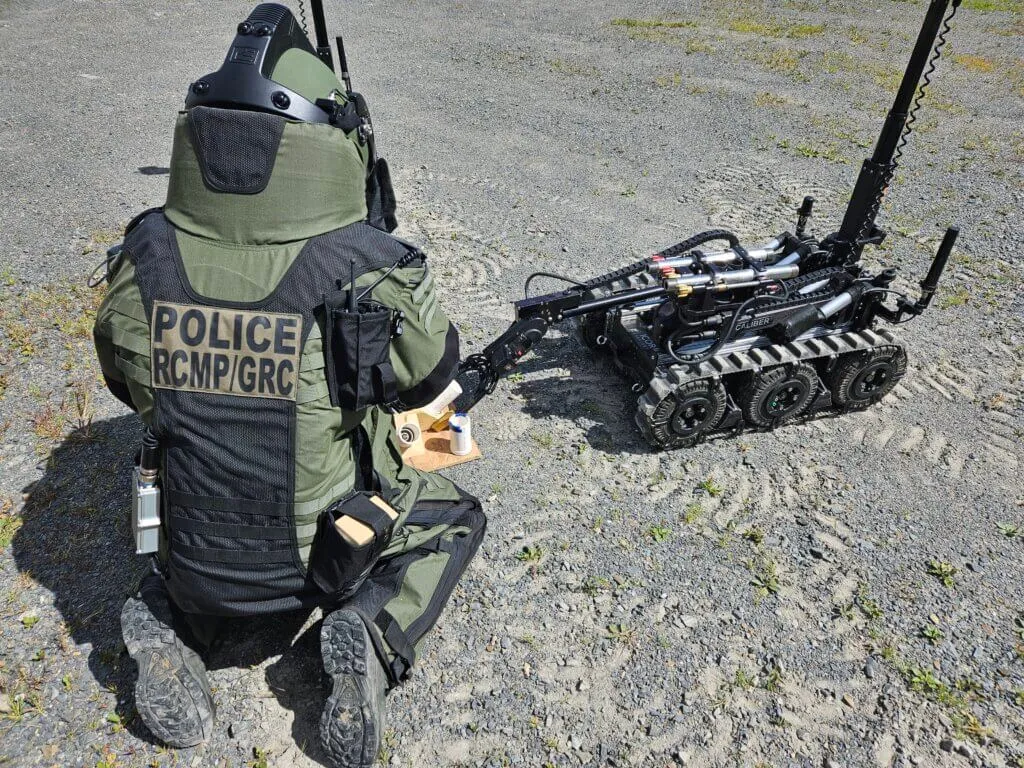
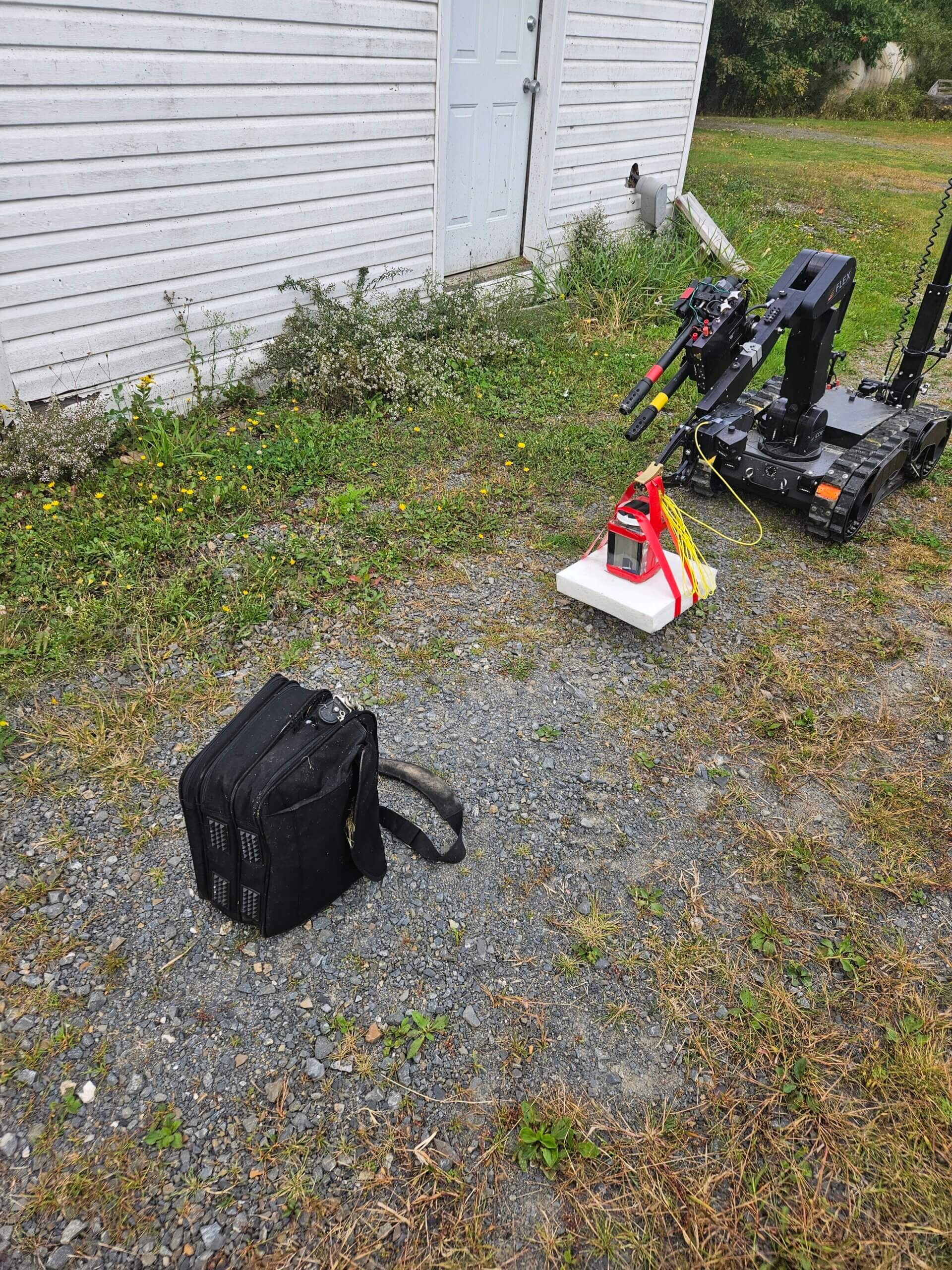
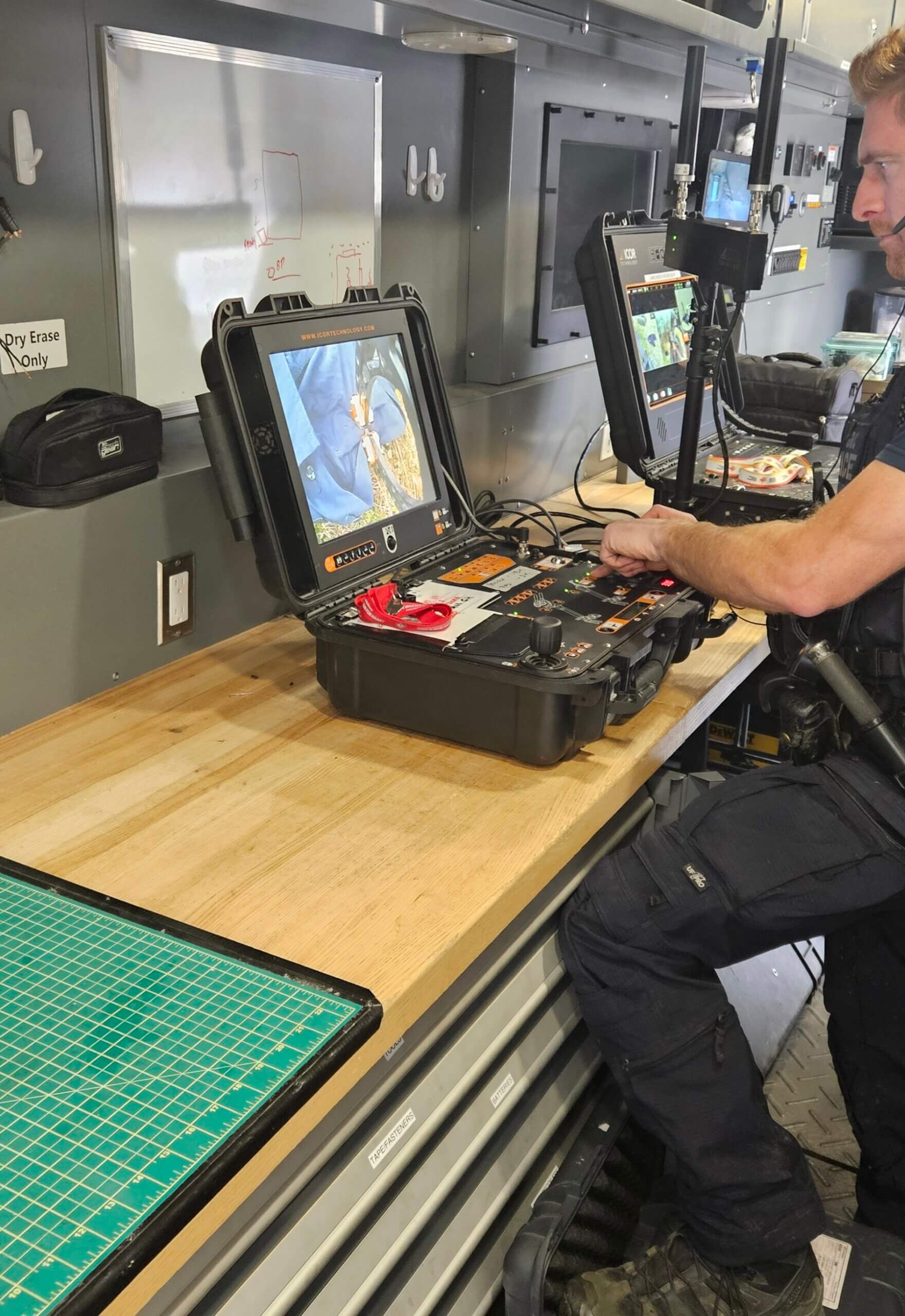
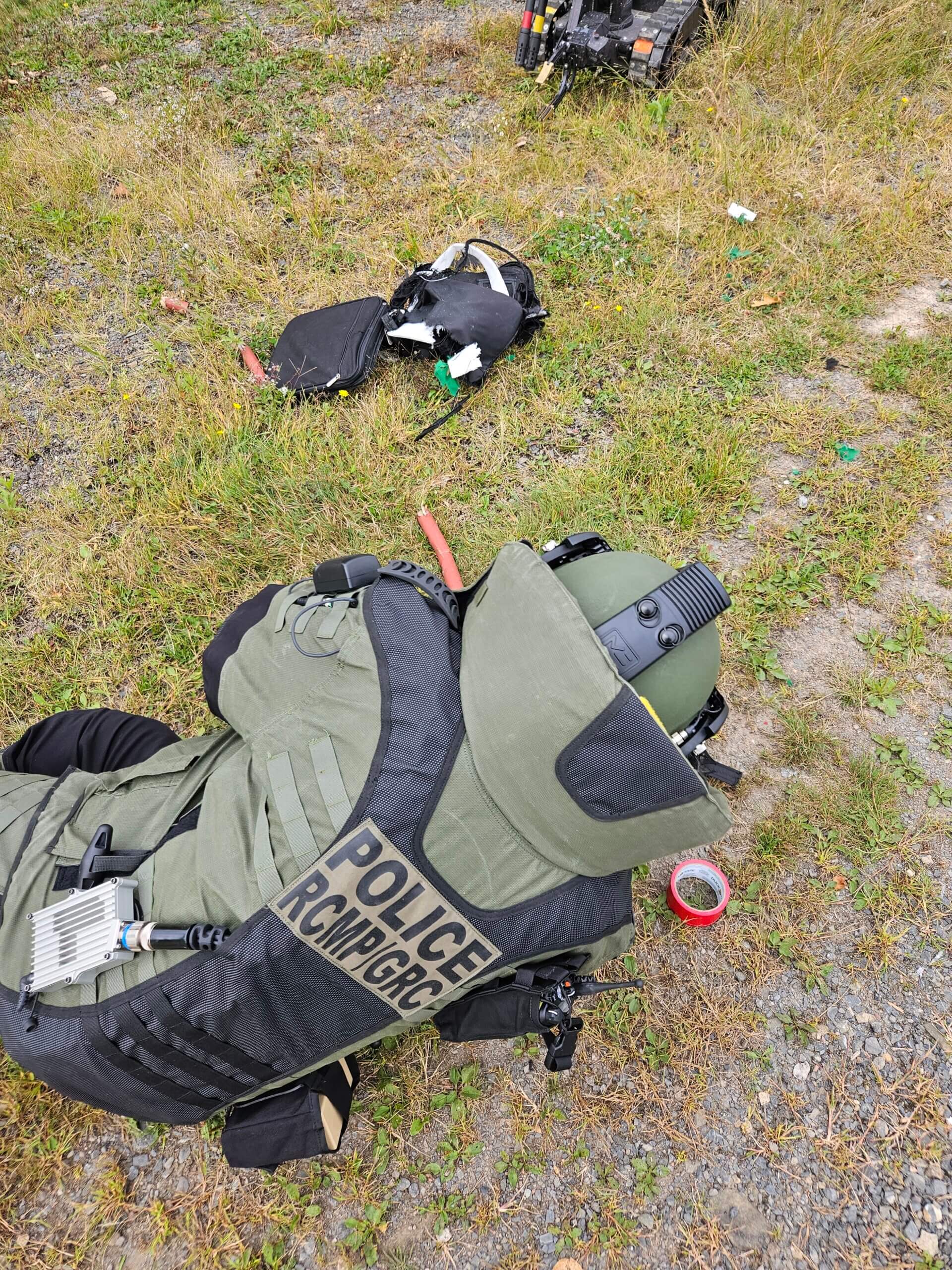
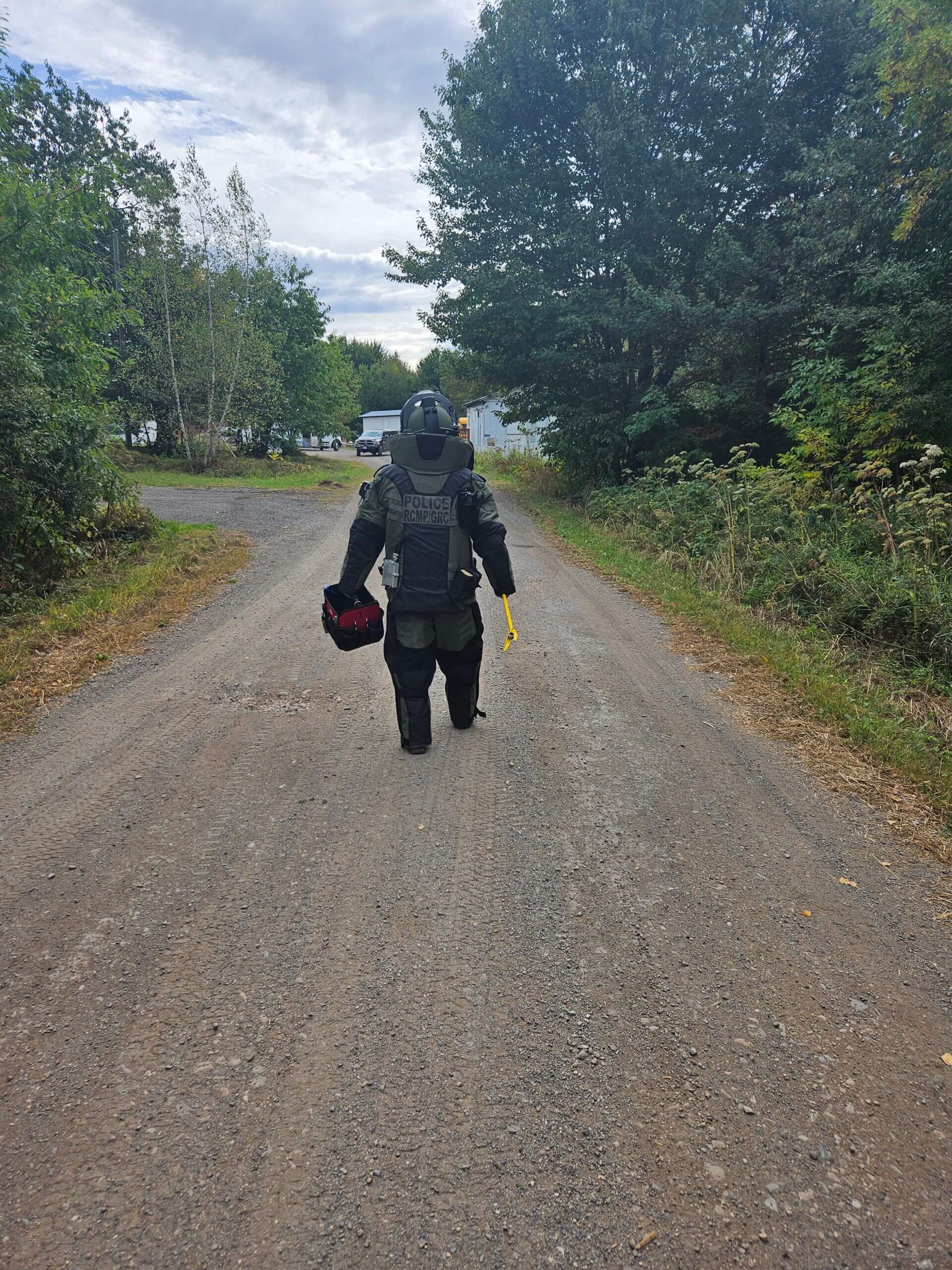
“We’re on the third or fourth generation of remotely operated vehicles,” Peter explained. He has witnessed a number of advancements over his 25 years of service. “We’re on our fourth generation of bomb suits, and we’re at least three generations in on technical equipment like X-ray equipment.”
50 Years: RCMP Explosive Disposal Units — Everyone Goes Home (Part 2)
For 50 years, the RCMP’s Explosive Disposal Units (EDU) have responded to dangers most Canadians never see. This three-part series explores the people, philosophy, and evolution behind one of policing’s most exacting specializations.
Part 2 of 3 examines how the work evolved through the career of Sgt. Jamie Briggs, whose experience underscores a core EDU truth: technology creates distance, not safety—and success is measured by whether everyone goes home.
–
Before the time Sgt. Jamie Briggs joined the RCMP in 1980, he had already spent a decade with the RCMP Emergency Response Team. He recalls working collaboratively with an RCMP bomb entry expert, who encouraged him to explore the specialization with the RCMP. Jamie was sworn into the RCMP and eventually became the EDU Coordinator for H Division and supervised the Atlantic Region CBRNE Team, leading as the sole full-time technician across multiple provinces for 17 years.

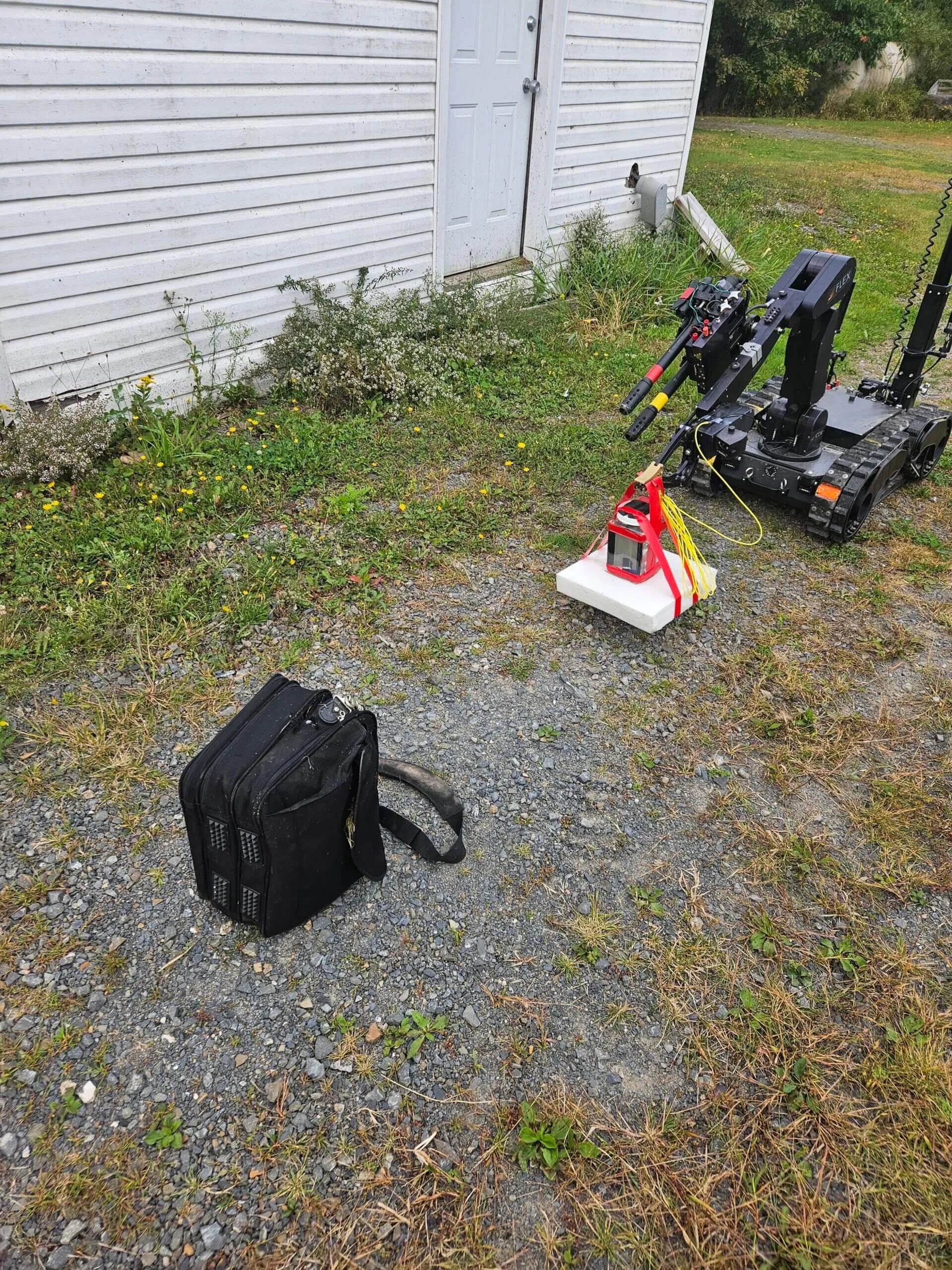
Over the years, technology transformed the field. Robotics, digital X-rays, and advanced chemical detection tools allowed EDU technicians to assess threats from a distance. Jamie embraced these innovations but remained clear-eyed about their limits.
“Technology gives you distance,” he said. “It doesn’t make the job safe.”
He remembers one barricaded-person call in Stewiacke, Nova Scotia, where a subject fired directly at an EDU robot.
“I didn’t lose a Member,” Jamie said. “I lost a camera. That’s a success.”
Not all hazards could be mitigated remotely. In 2005, during what he thought would be a routine disposal of expired marine flares in Liverpool, Nova Scotia, an explosion tore through a secure garage. Jamie survived, but the blast left permanent injuries: part of a finger gone, eardrums ruptured, shrapnel embedded in his upper body.
“If someone had been standing next to me,” he said quietly, “they wouldn’t have survived.”
He returned to work just weeks later, motivated not by bravado but by responsibility. Yet he never underestimated the toll on those at home.
“I handled it,” he said. “But my wife carried it longer.”
Through it all, Jamie’s philosophy was simple: no heroes.
“Everyone goes home,” he said. “That’s the measure of success.”
Despite the danger, Jamie reflects on the evolution of EDU with awe.
“When I started, we only had a flashlight, a revolver, and a set of handcuffs,” he said. “Now we have robotics, advanced chemical detection, digital X-ray… the capability we have now is incredible.”
But he stresses that even the most advanced tools don’t eliminate the human element. Each call demands judgment, precision, and restraint under intense pressure.
From secure detachment garages to barricaded homes, Jamie’s career demonstrates that explosives work is about more than technical skill. It’s about responsibility, trust, and preparation, knowing that every decision can mean the difference between life and death.
For Sgt. Briggs, the lessons of a lifetime are clear: training and technology are essential, but the ultimate measure of success is the same it’s always been—keeping your team and the public safe, and ensuring everyone goes home.
Then vs. Now: How the Work Has Transformed
1970s–80s
- Hotsticks and rope kits
- Heavy, military-style bomb suits
- No (or low-tech) robotics
- Single-shot X-ray plates
- Minimal protective standoff
- Small teams, often travelling long distances alone

Today
- Advanced, lightweight bomb suits influenced by Canadian research
- Specialized robotics capable of precise manipulation
- Digital X-ray systems with instant imaging
- Jammers, disruptors, and precision tools
- National standards for training and response
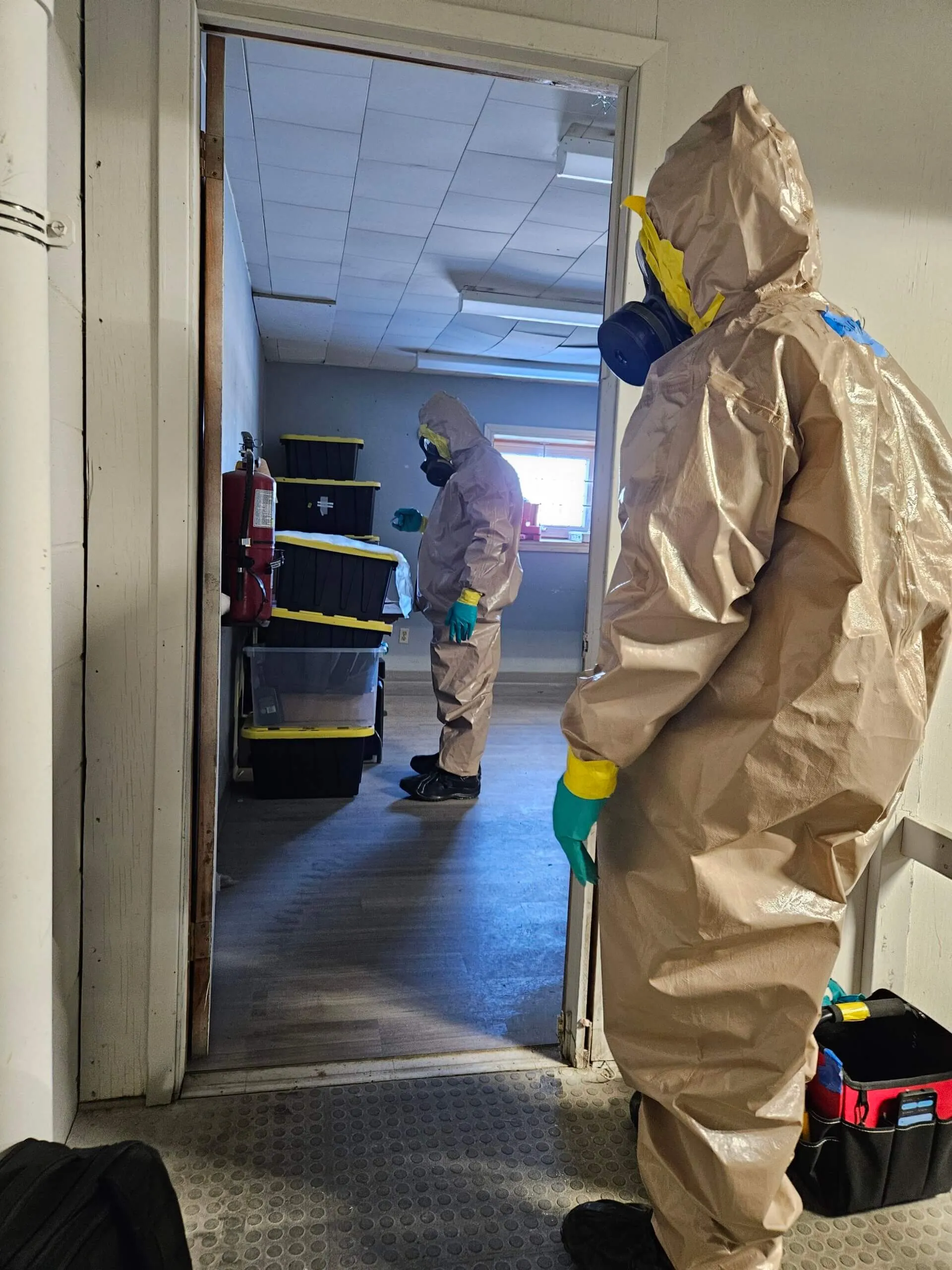
- Integration with CBRN (chemical, biological, radiological, nuclear)
- Strong interagency partnerships with military and municipal bomb squads
The difference is profound—but the heart of the work remains the same.
Canadian Ingenuity on the World Stage
One of EDU’s most significant contributions has been its influence on global bomb disposal standards.
Canadian research helped shape the design of modern bomb suits used around the world. Canadian technicians developed procedures that other nations adopted.

Canadian EDU units became known for professionalism, creativity, and collaboration.
Even today, international partners sometimes remind Canadian bomb techs:
“Your methods? We use those now too.”
—
As tools advanced and standards strengthened, one truth never changed: explosives disposal ultimately comes down to judgment.
In Part 3, we move into the present day—where national coordination, policy, and leadership intersect—and meet the people responsible for making the hardest calls when there are no perfect answers.
50 Years: RCMP Explosive Disposal Units — The Early Years (Part 1)
For 50 years, the RCMP’s Explosive Disposal Units (EDU) have responded to dangers most Canadians never see. This three-part series explores the people, philosophy, and evolution behind one of policing’s most exacting specializations.
Part 1 of 3 traces the origins of RCMP explosives disposal, from its early, close-quarters beginnings to the foundational training, culture, and discipline that still shape the work today.
–
Just after sunrise on a rural farm in 1970s Canada, two RCMP explosives technicians stepped through frost-locked grass toward a dilapidated building. Today’s call for service hadn’t come from a crime scene. It came from a landowner who discovered decades-old dynamite when clearing a crumbling barn.
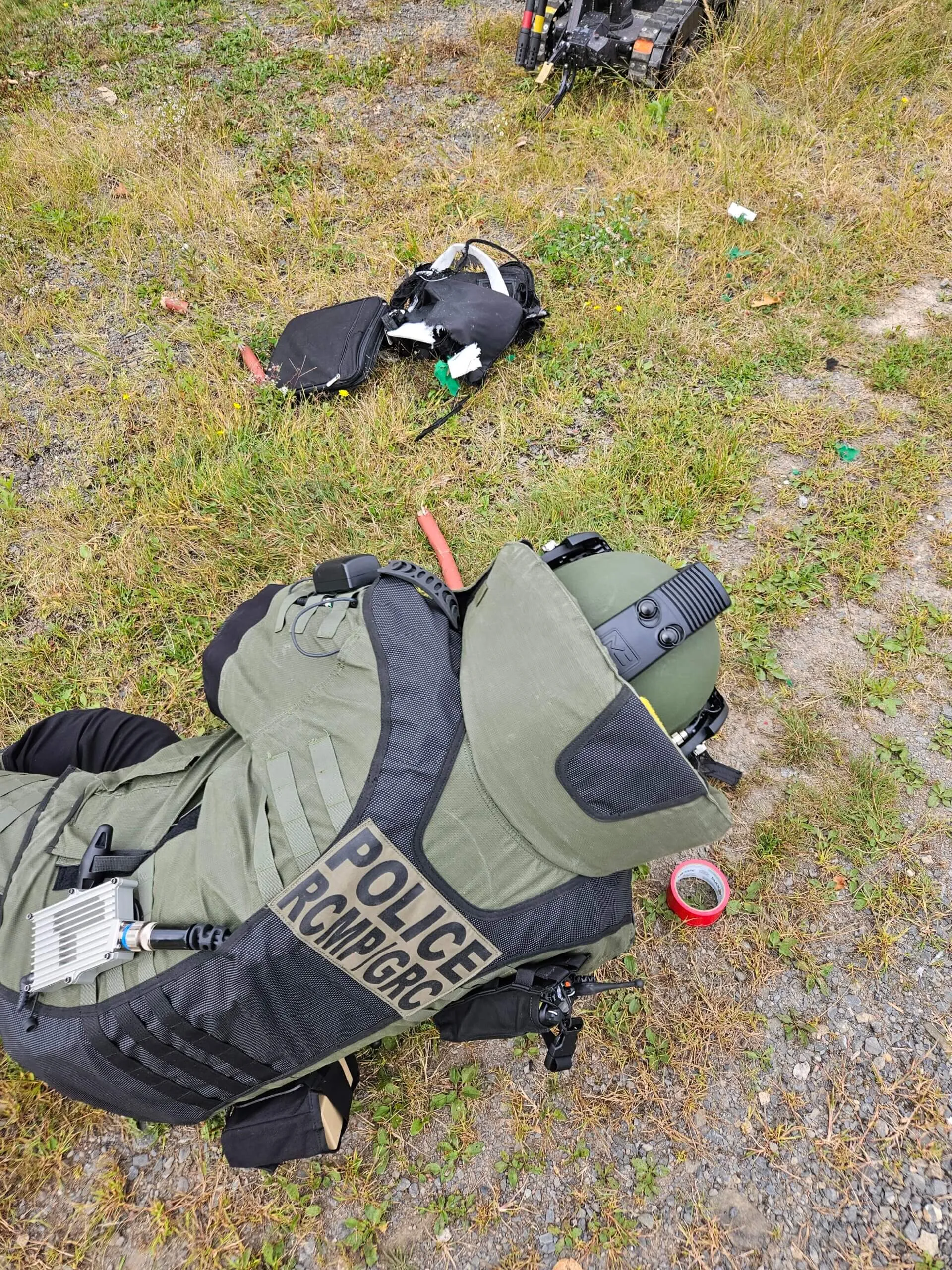
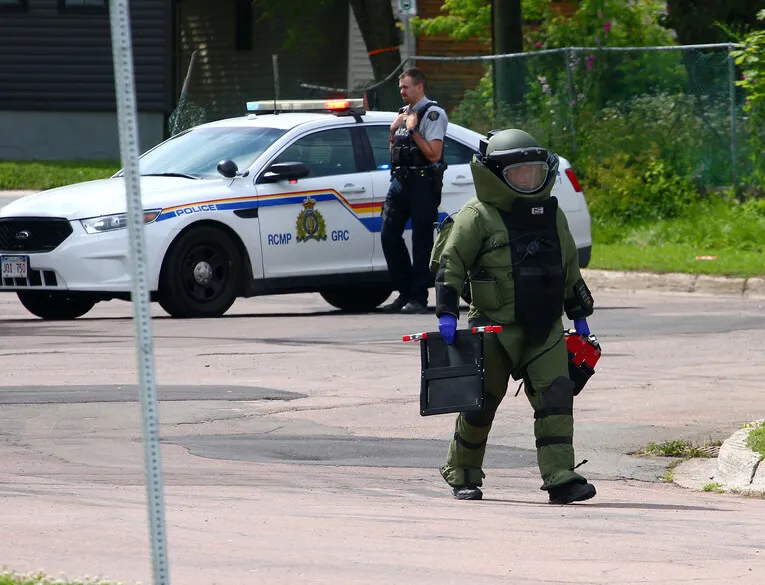
What they carried reflected that era’s “high-tech” safety equipment: a heavy protective bomb suit, a portable shield, and long tools that offered only a few extra feet of distance from aging dynamite made more unstable by time.
In those early years, explosives disposal was close work. Safety depended on training, discipline, and the trust between Members standing only a few steps apart. If nothing happened, the outcome was invisible: no headlines, no explosions, just the quiet certainty that a risk had been removed and a family’s land made safe.
The RCMP’s Explosive Disposal Units (EDU) have responded to dangers most Canadians never see for the last half-century, their success marked by the absence of devastating disaster.
Origins: Building a Discipline
The RCMP’s Explosive Disposal Units formalized at slightly different times across Canada around the mid-1970s, as global threats evolved and police agencies began to recognize the need for specialized expertise. For example, the BC RCMP marks 1975 as the founding year of its Explosive Disposal Unit, a 50th anniversary milestone they recently commemorated. Elsewhere in the country, similar capabilities were developing in parallel.
Nationally, the RCMP relied heavily on the Canadian Forces during these formative years. Early bomb technicians trained at Canadian Forces Base Borden (CFB Borden), completing demanding military explosives courses originally designed for soldiers. The instruction was uncompromising, and the expectations were clear.

“They drilled patience into you,” recalled Sergeant Lev Jackman, Officer in Charge of New Brunswick’s (J Division) EDU from the late 1980s to his retirement in 2000. “You didn’t rush. You didn’t guess. You took your time because if you didn’t, somebody could die.”
When Lev joined the RCMP in 1967, explosives disposal was not yet a recognized specialization. After eight years with the RCMP, he was transferred to his Division’s Security System section in 1975, where bomb-threat planning formed part of his responsibilities. A year later, he was formally introduced to explosives disposal when a Special Constable trained in Explosive Ordnance Disposal arrived from the military to coordinate all EDU activity. At the time, responsibility for explosives response sat alongside federal building security and depended almost entirely on military expertise.
In 1978, Lev attended a six-week explosives course at CFB Borden, delivered entirely by military instructors. “It was a very intense course that tested the mind and body,” he said. “The instructors taught us the dangers associated with different types of explosives, including Improvised Explosive Devices (IEDs).”

Over his years with EDU, Lev became the EDU Coordinator for all VIP visits and major events in New Brunswick, worked closely with the RCMP’s Emergency Response Team on files involving explosives, and led the safe disposal of abandoned explosives, ammo, chemicals, and criminally placed IEDs.
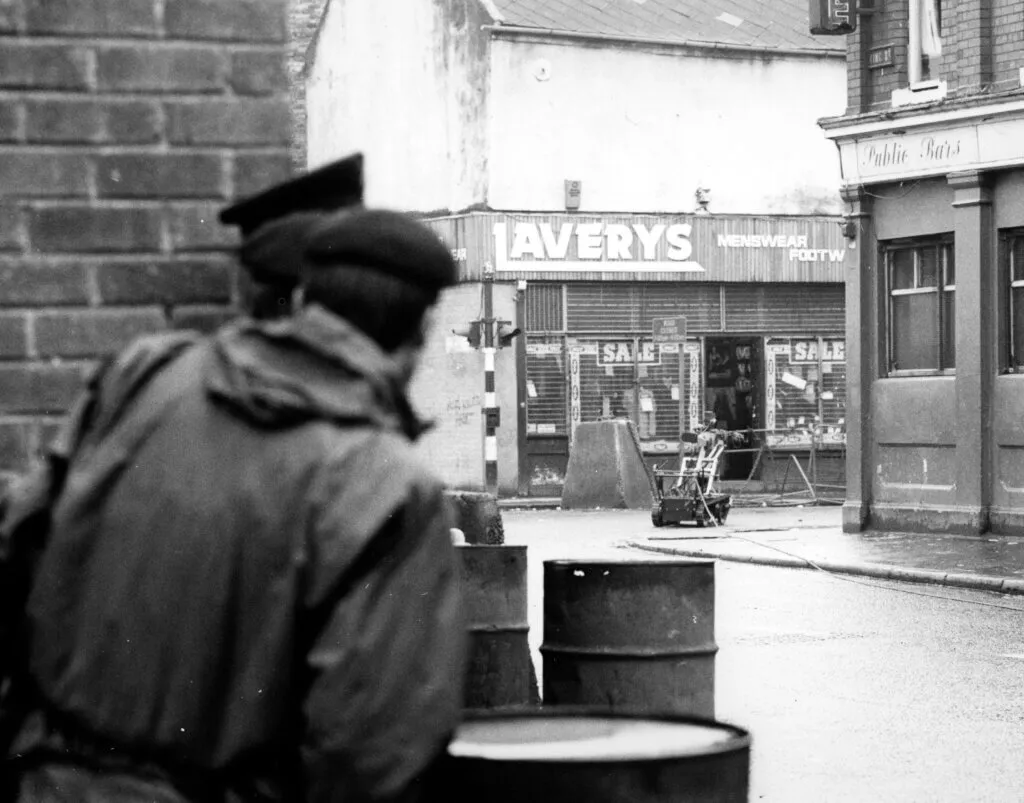
Looking back, he notes how distant that working reality now feels. There were no robots and no remote tools. Bomb suits were heavy and restrictive. Equipment was basic, and proximity to danger was unavoidable.
Much of the work during those early years focused on prevention rather than response. Members assisted with bomb-threat planning, assessed federal buildings, and worked behind the scenes to reduce risk before incidents ever occurred. Many calls resembled the opening scene of this article—unstable explosives discovered during renovations or land clearing.
What emerged during this period was not a unified national unit, but a discipline built incrementally, region by region, by Members willing to step into a role with no clear roadmap.
The history of RCMP Explosive Disposal Units is best understood not through equipment lists or organizational charts, but through the people who carried its responsibility. They did so quietly, often without recognition, and always with the knowledge that there was no margin for error.

Origins: Building a Discipline
By the early 1980s, explosives training had moved to the Canadian Police College (CPC), marking a turning point: the RCMP was defining explosives disposal as a policing discipline shaped by operational realities.
It was into this evolving environment that Special Constable Yves Pelletier would eventually step.
Yves had long hoped to join the RCMP but was turned away as a teenager. Determined to serve, he joined the military at just 16 in 1963. His early career placed him at pivotal moments in history, including deployment to Egypt during the Six-Day War in 1967, just days before hostilities broke out. He even recalls driving through machine-gun fire to retrieve critical documents for the United Nations.

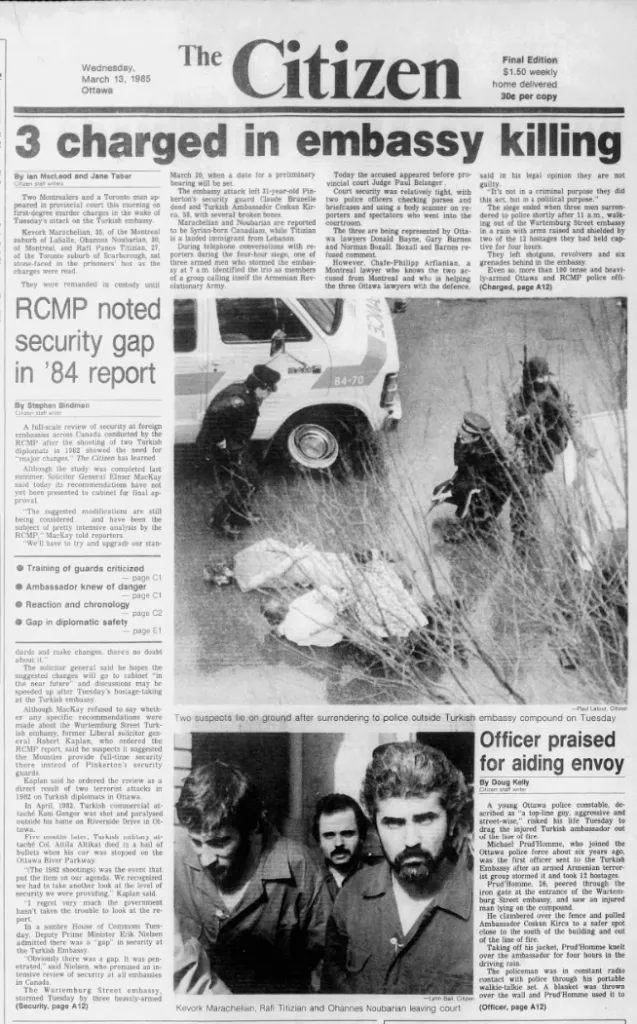
The RCMP’s Canadian Bomb Data Centre (CBDC) had been established in Ottawa in the late 1960s and early 1970s to collect data, provide training, and share intelligence internationally on illegal explosives and post-blast investigations. Its role became even more urgent in 1985, when agents of the Armenian Revolutionary Army attacked the Turkish Embassy in Ottawa, killing a security guard and using a homemade bomb to breach the building. In the aftermath, and to prevent future tragedies, the CBDC created 26 Special Constable positions, drawing from former and serving members of the military and various police services.

Yves was among those selected, well-qualified through his career as an Ammunition Technical Officer trained in the United Kingdom and his degree in Explosives Engineering. Sworn in with the RCMP, he also became a guest instructor at the CPC, teaching courses on booby traps and explosives recognition.
His work extended internationally. Yves travelled to Europe four times to exchange or obtain explosives from British, Israeli, French, and Swiss counterparts. He even obtained SEMTEX A (used in construction/mining) and SEMTEX H (used in military applications) directly from the factory in Semtín, Czechoslovakia, on the order of the Inspector of the Canine Training Unit. Yves distributed the SEMTEX samples and trained dog handlers across the country, enabling canine units to safely identify and handle these substances.
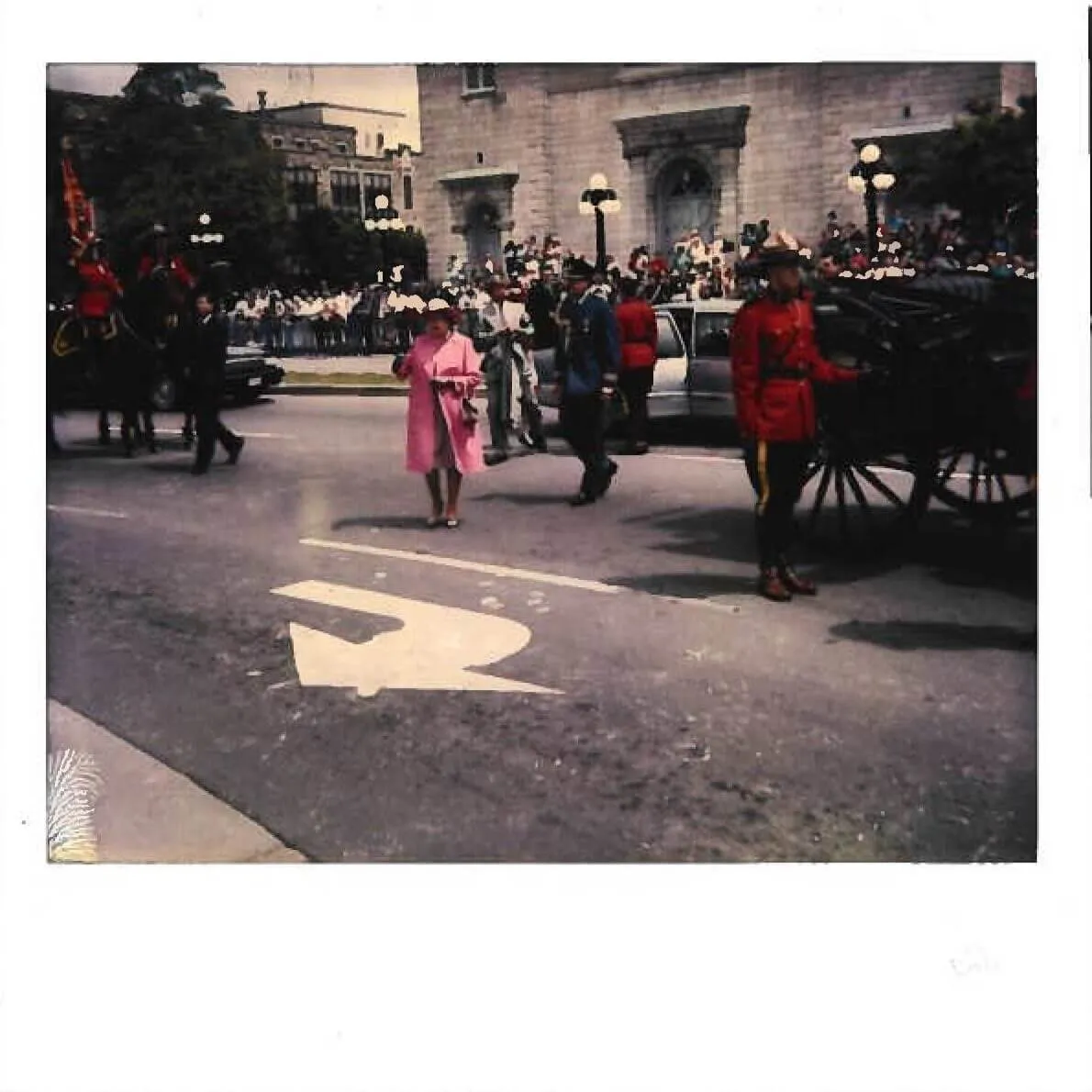
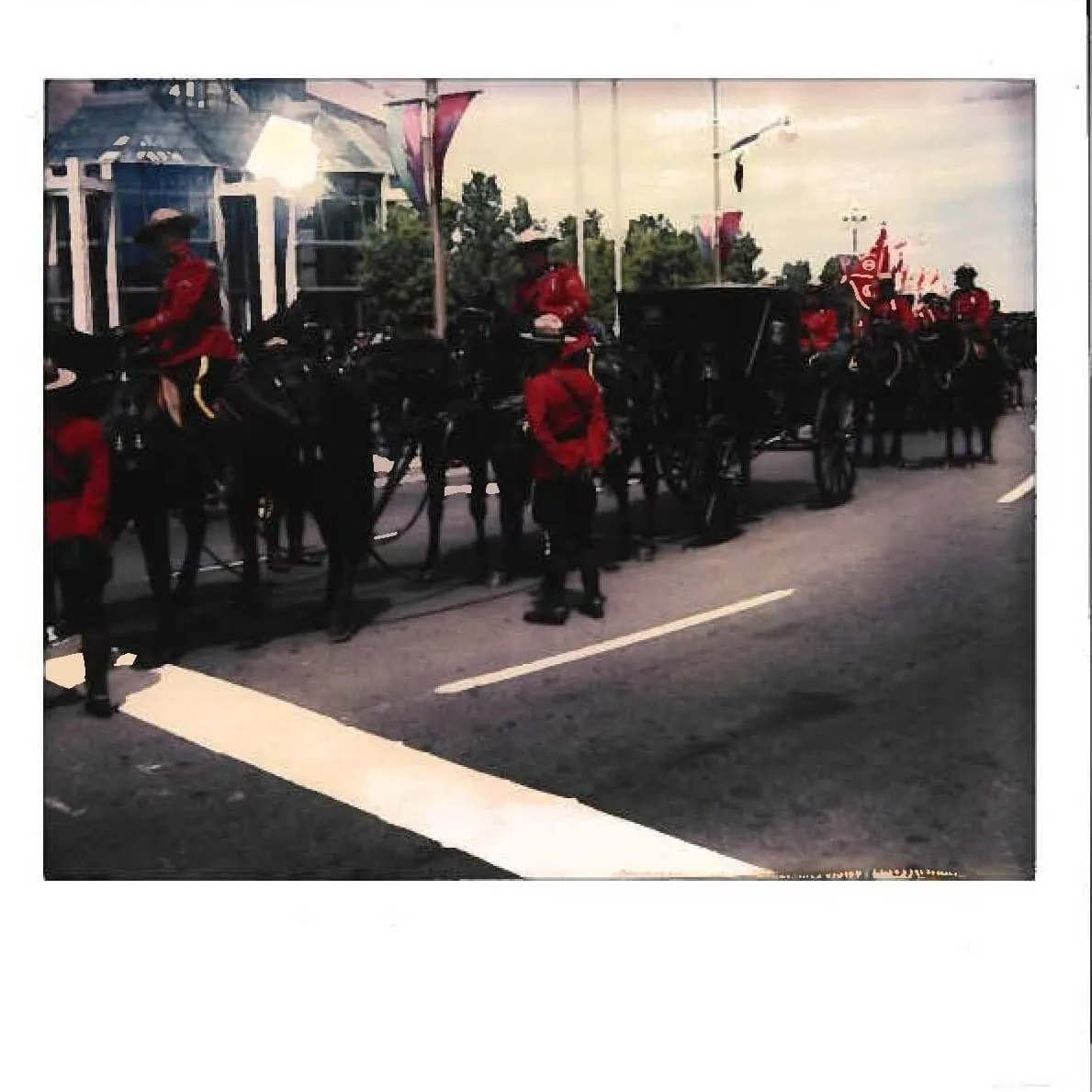
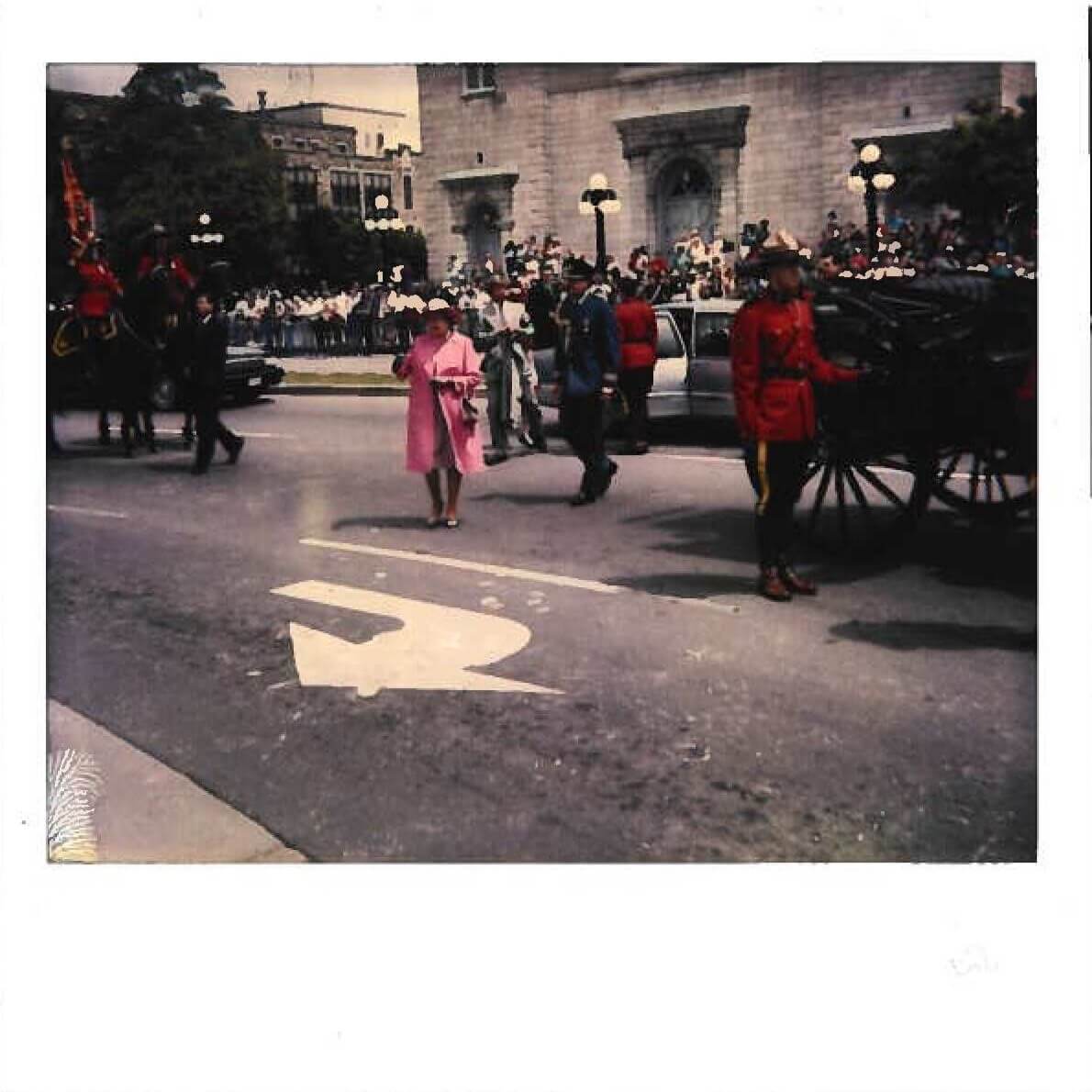
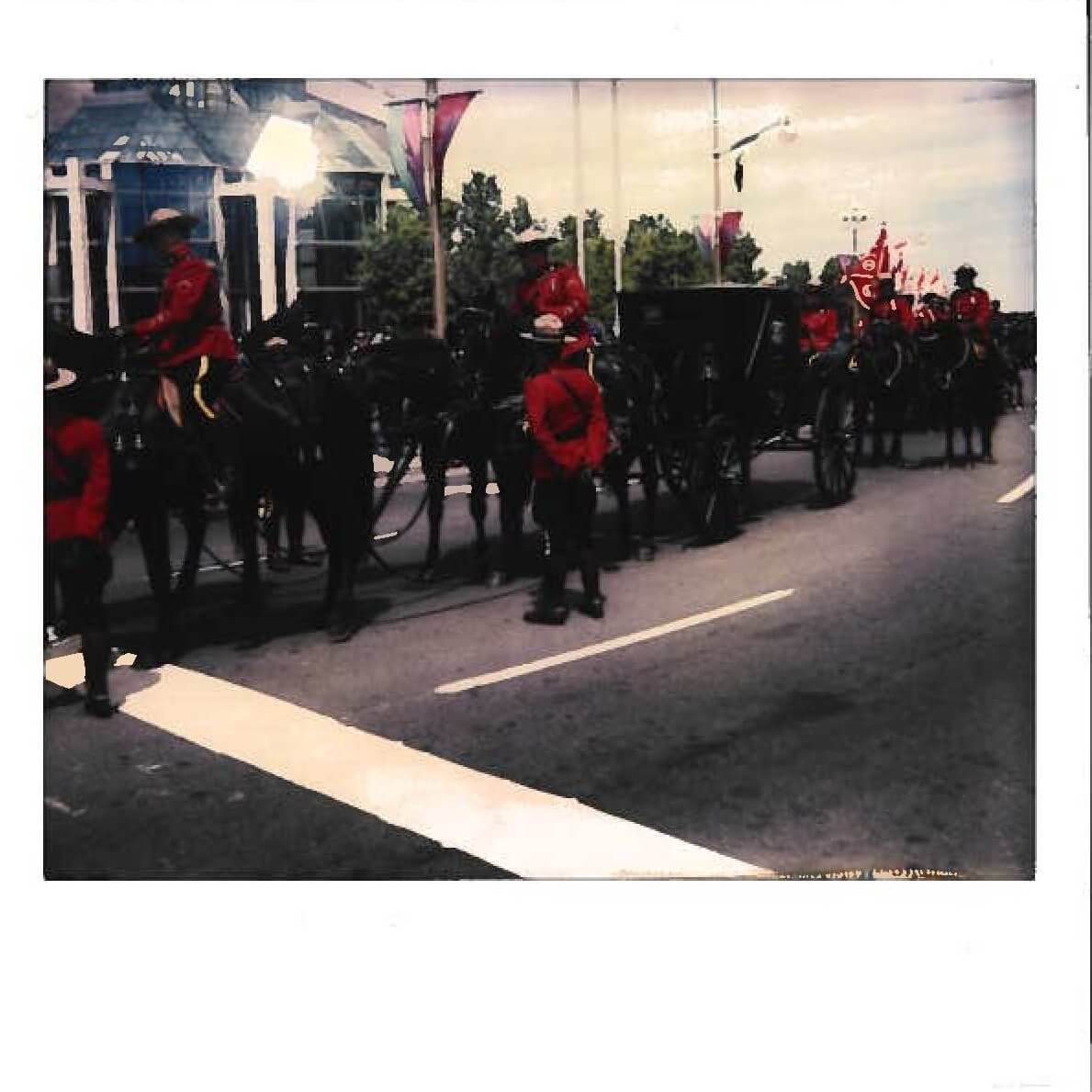
By 1987, Yves had become central to strengthening the CBDC’s capabilities, vetting all nationally issued bulletins, training new technicians, recreating Improvised Explosive Devices (IEDs) for instructional use, and gathering intelligence from around the world to keep Canadian technicians ahead of emerging threats. He also supported high‑profile operations, including royal visits by Queen Elizabeth II, Prince Philip, and the Governor General, meticulously searching venues for explosives.
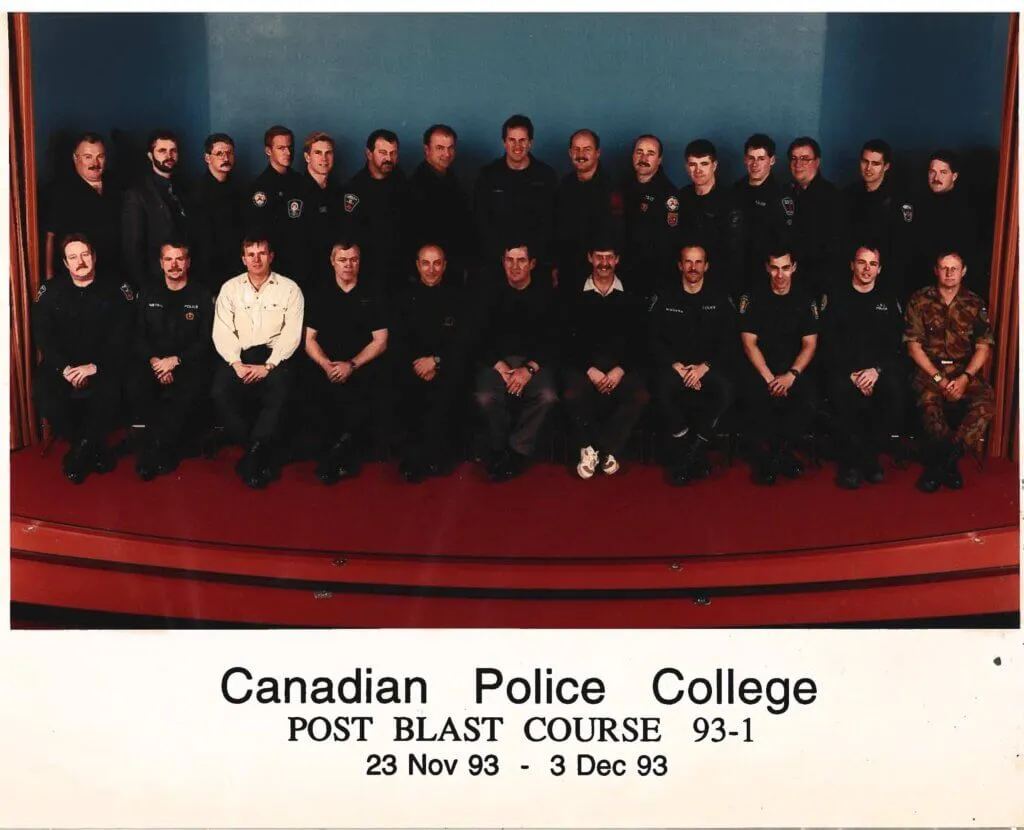
Bomb school itself was housed in an unremarkable old band building on the CPC campus, but the experience left a lasting mark.
“Bomb school changed how you thought about everything,” Yves said. The training didn’t just teach technical skills, it rewired how Members approached risk, patience, and decision-making. Everyday objects, ordinary environments—nothing felt casual anymore.

Yet despite the intensity, Yves remembers the camaraderie. Shared meals, quiet jokes, and the gallows humour unique to high-stakes professions helped them endure.
“We worked hard,” he laughed, “but we also kept things light. Bomb techs have a certain sense of humour… it’s how you get through the pressure.”

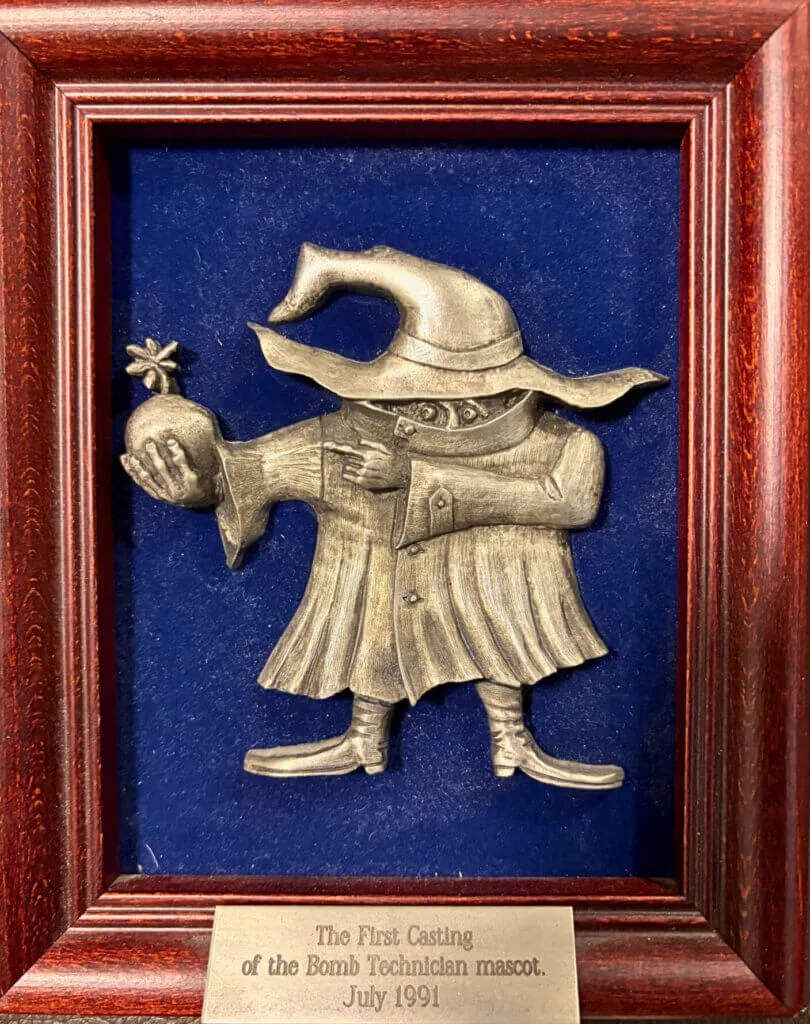
This pewter plaque was designed by E. Kew of Borden, Ontario and represents the officially registered mascot of all Canadian Police and Military explosives technicians, protected under copyright since 1982. Each plaque was individually numbered and recorded by the Canadian Bomb Data Centre. The mascot draws its inspiration from Guy Fawkes, whose 1605 “Gunpowder Plot” made him one of history’s earliest known criminal users of explosives.
From training rooms to tarmacs and secure venues, Yves’ career reinforced a core truth: explosives disposal never exists in isolation. It intersects with aviation security, protective policing, major events, and public confidence. What the RCMP was building was not just technical capability, but a culture grounded in discipline, adaptability, and trust.
–
What began as close, dangerous work with limited tools gradually evolved into a specialized discipline defined by patience, judgment, and trust.
In Part 2, we follow that evolution through decades of technological change—and through the career of a bomb technician who led by a single, unwavering principle: everyone goes home.
Guardians of the Games: How the RCMP Made the Olympics Safe
When Canadians tuned in to cheer for athletes chasing gold at the Vancouver 2010 Winter Olympics, the world saw excellence on ice and snow. What most didn’t see was the immense planning and expertise behind the scenes to keep the Games safe — work that demanded dedication, adaptability, and unwavering teamwork from RCMP Members and partners across the country.
From the early planning stages in 2003 through to the closing ceremonies in 2010, delivering Olympic security was a years‑long commitment. It required anticipating risks, coordinating across jurisdictions, and preparing for every possible scenario long before the Olympic flame was lit.
Early planning involved mapping every jurisdiction the Games would touch — from the streets of Vancouver and the speedskating oval in Richmond to Cypress Mountain, Whistler’s alpine venues and village, and all points in between, including the Sea-to-Sky Highway. At the same time, the RCMP focused on building strong partnerships with law enforcement, emergency services, and government agencies nationwide.
The RCMP served as the lead agency responsible for establishing the Vancouver 2010 Integrated Security Unit (V2010 ISU). This unprecedented collaboration brought together police officers, military personnel, emergency responders, and federal, provincial, and municipal partners to create a unified security framework that protected both the world’s top winter athletes and the millions of fans who came to cheer them on.
That planning translated into a complex operational reality. With 10 main venues ranging from large arenas to remote mountain slopes, and more than 2,600 athletes competing throughout the Games, security operations were nuanced, wide-ranging, and constantly evolving.
NPF President and CEO Brian Sauvé experienced that reality firsthand. At the time, he was a Corporal with the RCMP deployed during the 2010 Games.
“While most people experience the Olympics as a celebration of sport and community, there are always those who view a global event like this as a target-rich environment,” Brian said. “The stakes are high. As RCMP Members, you prepare for the worst, hope for the best, and measure success in the small wins that keep people safe every day.”
ort major events behind-the-scenes? Check out NPF President & CEO Brian Sauvé’s story about policing during the 2010 Olympic Winter Games in Whistler, BC.
- More than 90,000 flights arrived in Vancouver related to the Games.
- The RCMP provided protection for approximately 30 world leaders and VIP dignitaries.
- RCMP Members with V2010 ISU processed security background checks for over 204,000 applicants, ensuring every volunteer and staff member was cleared to be part of the Games.
- Twenty-three marine vessels patrolled the waters around Olympic venues 24/7.
- More than 700 police representatives from 39 countries visited Vancouver during the Games to learn how the RCMP planned and executed security operations.
Yet much of the work to keep the Games remained invisible to the public. Police dogs and handlers quietly patrolled venues. Military personnel stood ready in surrounding forests. Emergency medical teams remained on alert. Explosive device sweeps were conducted without fanfare. It was quiet, steady dedication, the kind that allowed the athletes and fans to focus on the thrill of competition, while Canada’s finest focused on their safety.
On the ground, RCMP Members like Brian were deployed across the venues including small mountain villages and remote venues for up to 40 days, even though the Games themselves lasted just 12. Specialized skills including advanced skiing ability, deep knowledge of the terrain, and familiarity with local communities contributed to whether a Member was selected for these roles.
Brian’s assignment during the Vancouver 2010 Olympics was particularly unique. Thanks to his background as a competitive skier, he was assigned to uniformed ski patrol blending operational responsibility with extraordinary experiences.

His duties went beyond routine patrols and enforcement. Brian escorted Olympic athletes and coaches up the slopes, assisted them at the top of their runs, and even skied alongside them — if only for a few heart-pounding seconds — all while wearing his full RCMP uniform.
“It was surreal,” Brian recalled. “One moment I’d be on the lift with an athlete like Lindsay Vonn or Erik Guay, helping secure their runs. The next, I’d be enjoying the village in the evening, surrounded by fans from around the world, hearing every language imaginable.”
Looking back, Brian emphasizes that collaboration, preparation, and adaptability were critical to success. The lessons learned in 2010 continue to shape policing for major events today, now enhanced by drones, social media monitoring, body-worn cameras, and modern intelligence tools.
Away from the mountains, the Games were also an electrifying expression of Canadian pride and unity.
“We won a lot of medals, and sometimes you could watch multiple Canadians in medal ceremonies in a single day,” Brian said. “Thousands of people would gather, cheering and celebrating. There was a true sense of togetherness. It wasn’t just about sport; it was about being part of something bigger than yourself.”
Sixteen years later, Brian’s excitement from his time policing the 2010 Games still resonates as he prepares to cheer on Team Canada at the 2026 Games in Italy. “I’m looking forward to seeing the athletes push boundaries, of course, but also the human stories — the moments that bring everyone together,” he said. For Brian, the Games are a powerful reminder that behind every medal moment is a story of diligent preparation and unbreakable teamwork.
The parallel between RCMP Members and professional athletes is unmistakable. Just as athletes train for a defining moment, RCMP Members prepare relentlessly so that, when it matters most, the world can come together safely. As Canada prepares to host another world-class sporting event with the 2026 FIFA World Cup, the lessons learned in 2010 — and the skills refined since — will once again be on display, both in front of the cameras and behind the scenes.
From Rink to Ready: How Hockey Shaped Anne’s RCMP Career
For many Canadians, hockey is more than a sport. It’s a shared spirit of dedication, sacrifice, and teamwork. During the 2026 Olympic Winter Games (which are ongoing at the time of publication), that connection only deepens as we watch athletes represent Canada on the world stage after years of preparation that often go unseen.
That same steady commitment is something Anne Alary, an RCMP Staff Sergeant, understands well.
Before becoming the Non-Commissioned Officer in Charge of National Headquarters Explosives Disposal Unit and the Policy Centre in Ottawa, Anne was a high-performance hockey player, competing with the Ottawa Raiders in the National Women’s Hockey League.

A Team Photo of the Ottawa Riders from 2002. Anne can be seen in the third row, fifth from the left.
Today, she also serves as a U18AA Head Coach with the East Ottawa Stars and was recently announced as the new U22 Elite AA Assistant Coach with the Nepean Wildcats—developing the next generation of athletes while leading behind the scenes in one of the RCMP’s most specialized and readiness-focused environments.
Though the settings may differ, the mindset, skills, and dedication between being a professional athlete and a police officer are strikingly similar.

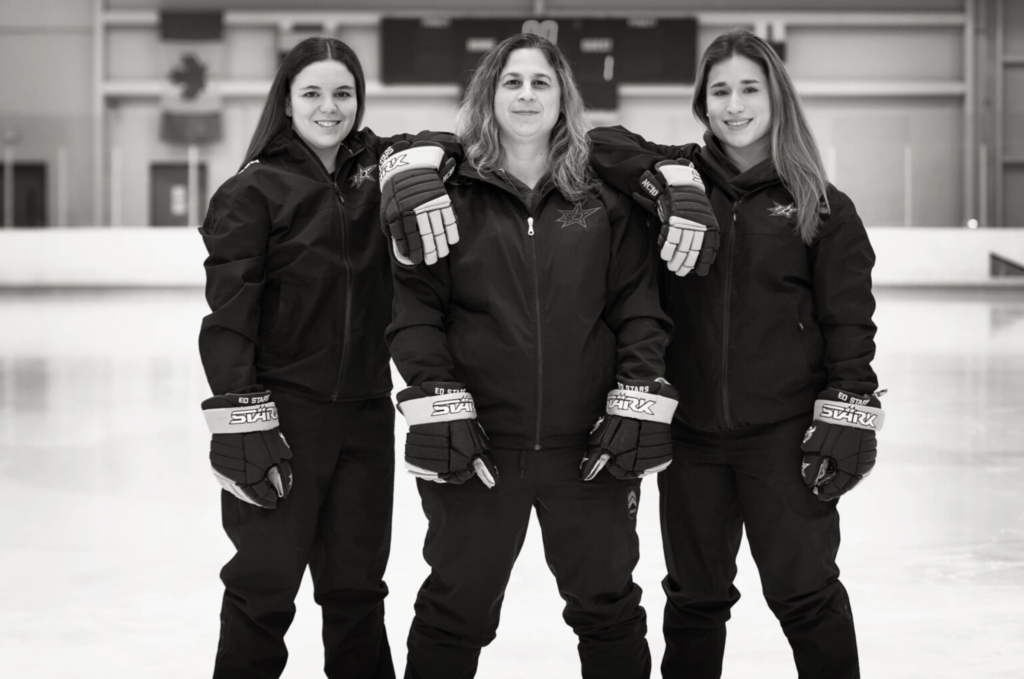
Anne (center) between the Assistant Coaches of the U18AA East Ottawa Stars.
Built on the Ice
Anne’s connection to sport started early. Growing up in a family deeply involved in athletics, she was constantly active—playing outside, skating on outdoor rinks, biking, and trying everything from basketball to ringette. But hockey was the constant.
“Competing at an elite level taught me discipline, focus, and resiliency,” she says. “There are personal performance expectations, but also the responsibility of being a reliable teammate.”
Playing against and alongside the best also meant constant pressure: competing for ice time, managing injuries, navigating team dynamics, and pushing through adversity. Those experiences shaped not only the athlete Anne became, but the policing leader she is today.

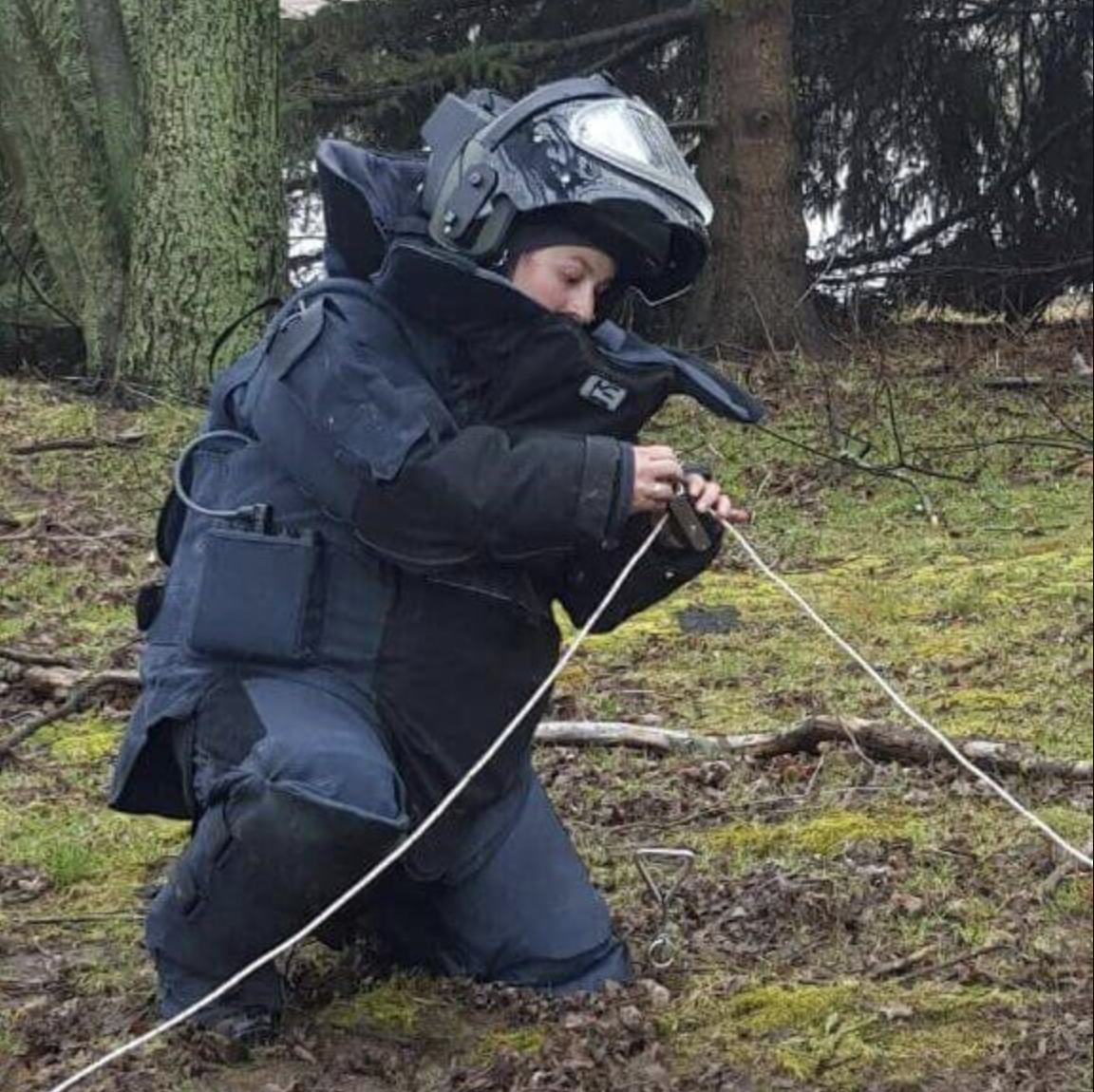
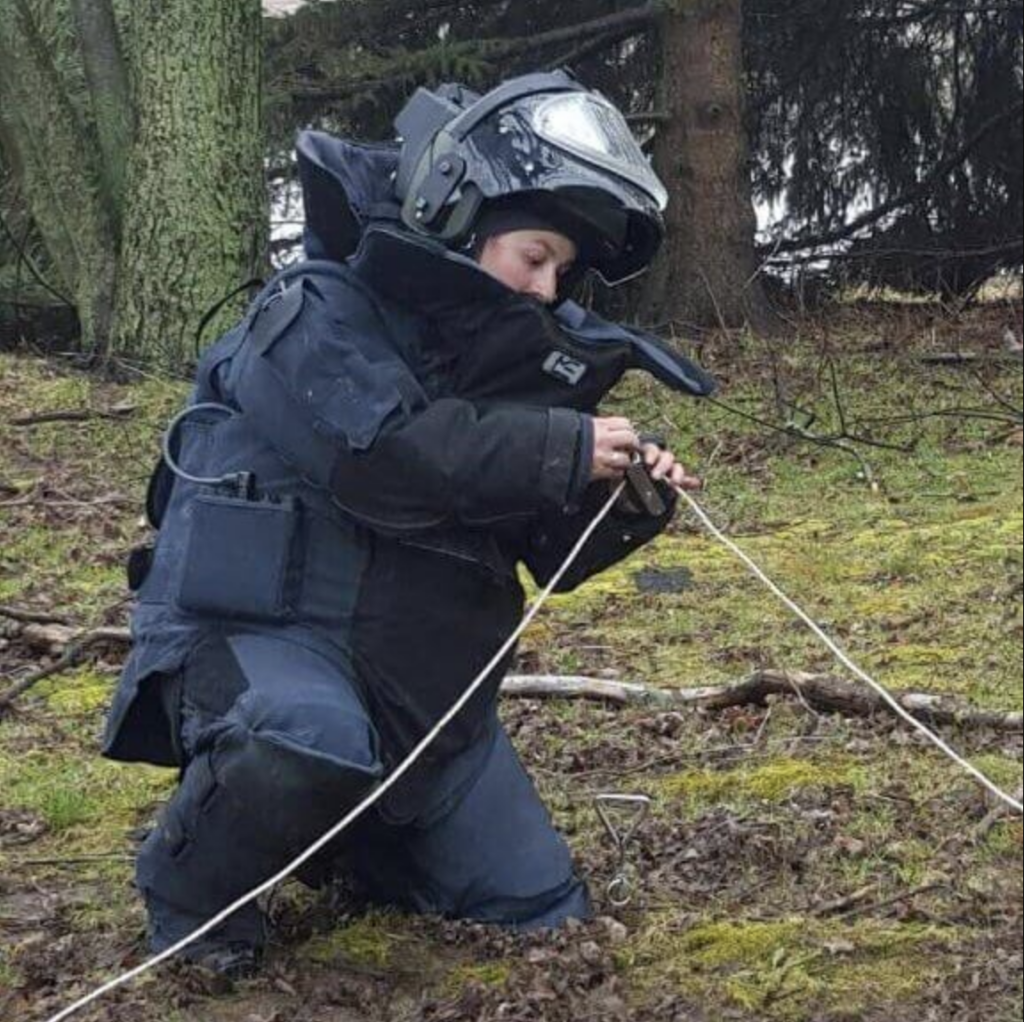
Anne is no stranger to high‑stress situations. In this photo, she takes part in scenario‑based training during the annual London Ontario Exercise, where EDUs from across the province come together to test their skills through a series of challenging scenarios.
“Staying calm in high-stress situations allows you to think clearly and make decisions based on experience,” she explains. This lesson translates seamlessly from the rink to policing.
Trust, Accountability, and Team Culture
At the heart of both hockey and policing is trust.
For Anne, understanding the accountability that comes with building trust isn’t just personal.
“When one person isn’t accountable, it affects the whole group,” she says. “You need to trust that everyone is working toward the same objective and will be there to support one another.”
As a coach, Anne prioritizes culture above all else. Creating clear expectations, setting high standards, and fostering accountability while ensuring athletes feel safe to learn and fail are foundational.

Coach Anne (right) poses for a photo with one of her talented, award-winning athletes.
“When people operate in a positive environment without fear, they thrive,” she says.
It’s an approach she carries into her RCMP leadership, where mentorship, growth, and open communication are just as critical as technical skills.
Long Before the Puck Drops
Anne’s current RCMP role places her largely behind the scenes, but its impact is national in scope.
Having served on the front lines across Canada—from rural Saskatchewan and Indigenous policing in Pelican Narrows, to Parliament Hill, the RCMP’s Musical Ride, and specialized operations—she brings a deep operational understanding to her work at National Headquarters Explosive Disposal Unit (NHQ EDU) and the Policy Centre.

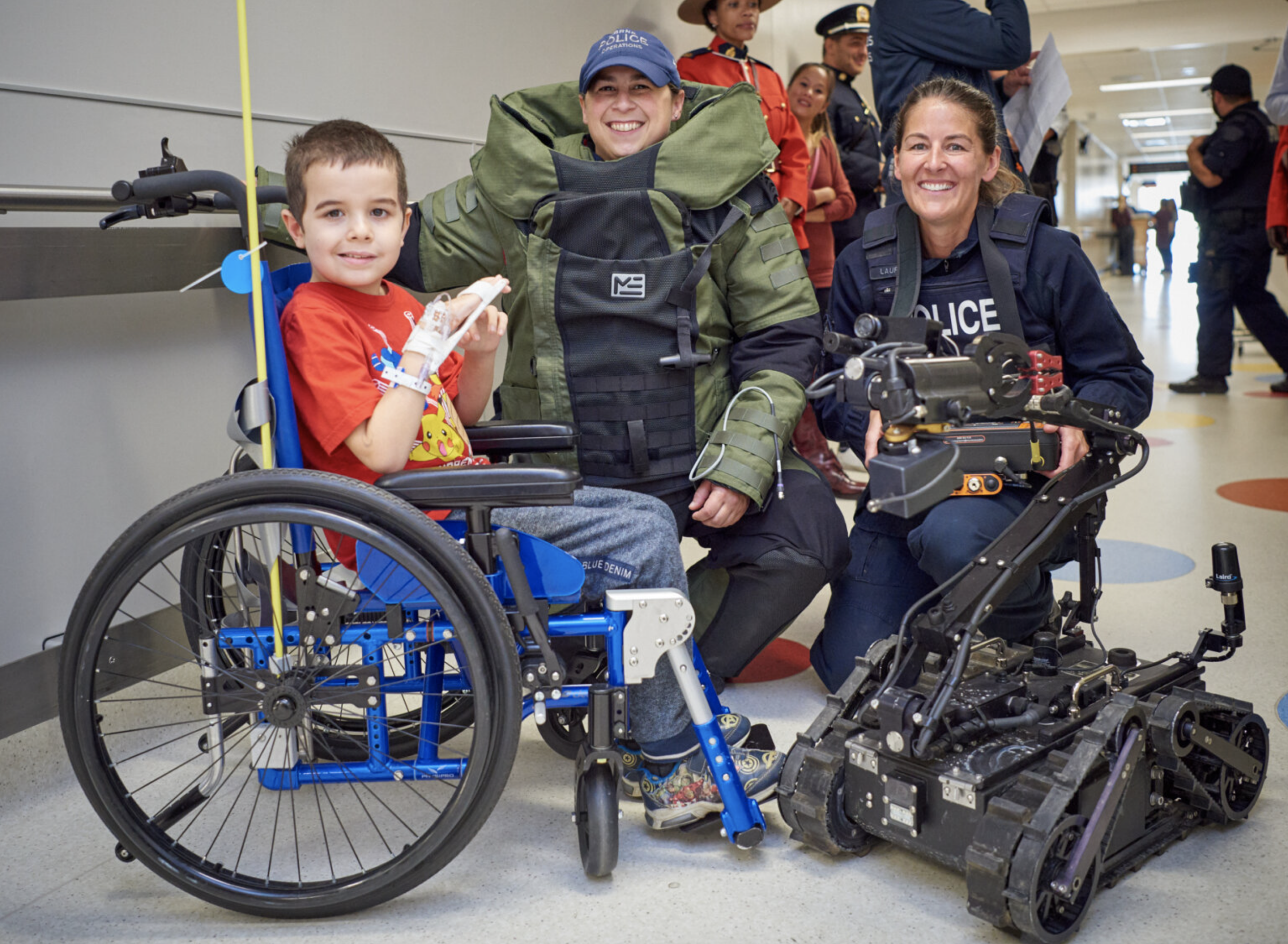
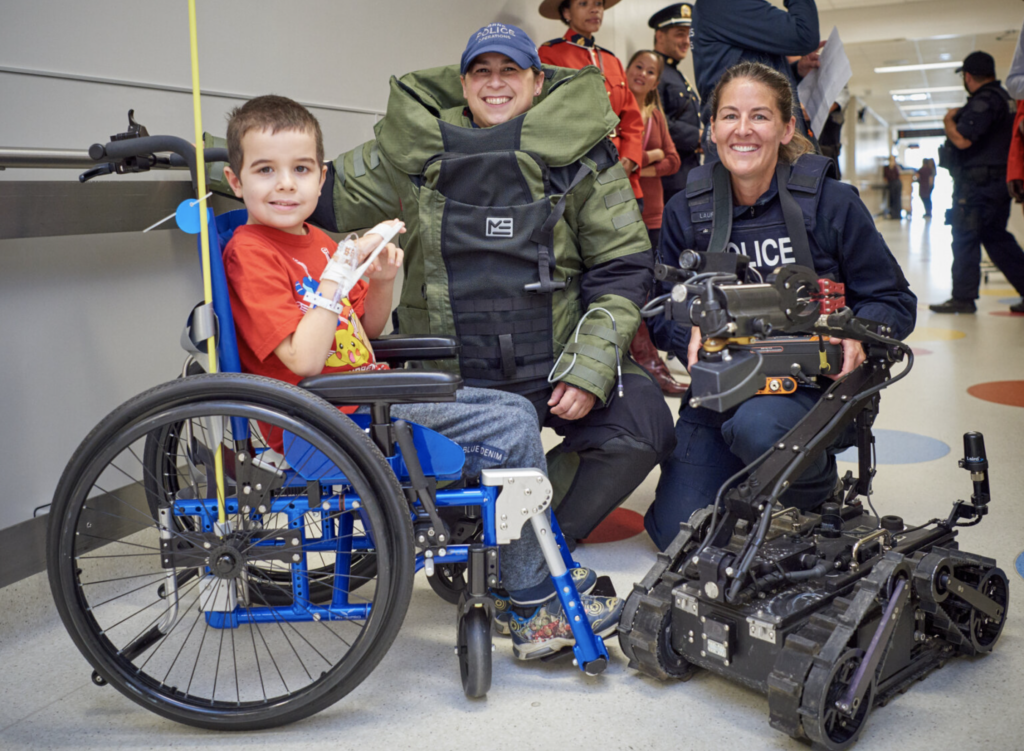
Anne (center), fellow bomb technician Sgt. Maryse Laurin (right), and one of the EDU’s robots are seen visiting a child (left) at St‑Justine Hospital in Montreal.
“Our role is about understanding what EDU teams across the country need and ensuring they have the equipment, policies, and procedures to do their jobs safely and effectively,” she explains.
The parallel to sport is clear: success on game day depends on habits built long before the puck drops.
“Habit setting is everything,” Anne says. “What you practise everyday transfers directly when it matters most.”
For EDU Members, consistency in training across a wide range of specialized skills ensures they are always ready to respond, whether during a major international event or an unexpected call for service.
What the Public Doesn’t See
When Canadians tune into the Olympics or Paralympics, they see moments that culminate from years of preparation. The same is true of policing major events.
“The public doesn’t always see the quiet expertise working in the background,” Anne says. “But Members maintain their skills 365 days a year so that, when something critical happens, they’re ready.”
That preparedness—preventative, precise, and often invisible—is what allows major events to unfold safely and seamlessly, whether it’s the Olympic Games, FIFA tournaments, or national celebrations.
Curious about how RCMP Members support major events behind-the-scenes? Check out NPF President & CEO Brian Sauvé’s story about policing during the 2010 Olympic Winter Games in Whistler, BC.
National Pride, Shared Values
As Canada competes in the Olympic Winter Games Milano Cortina 2026, Anne sees a powerful connection between athletes and RCMP Members: dedication, teamwork, and service cannot exist in isolation.
“In a team environment, you can’t have one without the other,” she says.
She’s watching the Games closely (especially hockey) and cheering on Team Canada alongside millions of others.
“Olympic years are the best,” she adds. “So many athletes juggle training with work, family, and life, yet still represent our country with pride. That dedication is incredible.”
Whether on the ice or behind the wheel of a police car, the commitment to excellence looks remarkably the same.
And like the best teams, it’s built long before the spotlight ever turns on.
Go Canada Go!
Beyond the Badge – Cst. Khanh Tran’s Dedication to Giving Back

RCMP Members are proud to serve their communities all across Canada. But they’re much more than your local police officer: they’re your neighbours, friends, sports coaches, and volunteers. Many Members give back far beyond their normal workday to help build their communities into safe, vibrant spaces.
As the holiday season approaches, we’re reminded of the power of compassion, community, and the simple act of giving back that unfolds all across Canada. Actions like the remarkable dedication and kindness of Constable Khanh Tran, a General Duty Member with the Burnaby RCMP in B.C., whose commitment extends far beyond her policing duties.

A Journey Into Policing
Cst. Tran’s journey began long before she earned the RCMP’s iconic Red Serge. Growing up in a military household shaped by her father’s service in Vietnam and her parents’ courageous journey to Canada, she learned early what sacrifice, hope, and new beginnings mean. Their story ignited her desire to serve the country that offered her family an opportunity; to give back in the same spirit that shaped her childhood.
From seeing RCMP Members in Nanaimo as a young girl to discovering the depth and diversity of policing roles across the country, she chose the RCMP with both admiration and purpose. Today, eight years into her career, she continues to serve on the frontline, where her passion lies. Whether responding to 9-1-1 calls, navigating the evolving complexities of a fast-growing city, or working shoulder-to-shoulder with a team she describes as “solid, quick, and always ready to back each other up,” she approaches her work with gratitude and strength.

Giving Back Beyond the Badge
But it’s her work beyond the badge — her dedication to Northern communities, especially those in Nunavut — that shines even brighter during this season of giving.
Through relief postings, Cst. Tran has spent time in Canada’s North, experiencing firsthand the warmth, simplicity, and resilience of the communities she served. The joy of children playing hockey at 2 a.m., the kindness of kids guiding her to an address when she was still learning the layout of her new town — these moments stayed with her. They reminded her of her own childhood, when, “less toys and more essentials” still came with big smiles.
In Nunavut she witnessed the challenges of accessibility for essential and fun items – like toys, and where everyday items often cost up to three times more. Those observations sparked a heartfelt determination to help.

Cst. Tran is making a meaningful difference for families and youth living in remote Northern communities. Four years ago. Cst. Tran got involved with a colleague’s charitable project which inspired her to try something herself. Initially, she worked on developing roughly 35 “holiday kits” filled with things like children’s books, school supplies, treats, and essentials. This year, she amplified her efforts even further.
She rallied colleagues, invited other Members and staff in the detachment to donate toys, coordinated community support, and even auctioned rare challenge coins to raise funds. Her dream? To one day support every community in Nunavut. Each year, she selects a different community by connecting with a Member traveling north for relief and coordinating with their detachment so the project can be shared face-to-face with the detachment commander. Over the years, she has reached Hall Beach in 2021; Pond Inlet in 2022; Naujaat in 2023-2024; and this year, all packages were sent to Kugaaruk, Nunavut—supporting children from kindergarten to Grade 4. One community at a time, she continues to move steadily toward her goal. This year alone, that meant more than 135 kits delivered to children and families across the North.

Service Before Self: A Calling, Not Just a Career
Her advice to others hoping to join the RCMP — especially those dreaming of Northern service — is shaped by experience: be willing to put in the work, stay compassionate, hold on to positivity, and know that there is a place for you here. She believes fiercely in breaking barriers and being the representative she hadn’t previously experienced.

As we embrace the warmth of the holidays, we celebrate Cst. Tran and the hundreds of other Members supporting their own communities — not only for her service, but for her heart. Her initiative reminds us that giving back doesn’t have to be grand; it just has to be genuine. And when one person leads with purpose, others follow.
When Every Second Counts: How RCMP Members Use AMBER Alerts to Save Lives
A missing child is every family’s worst nightmare.
Every year, approximately 45,000 children are reported missing in Canada, according to missingkids.ca. This translates to a child going missing every 11 minutes. Although many cases are quickly resolved, some become long-term missing persons police files.
For RCMP Members, solving these cases isn’t just about evidence and procedure: it’s about saving young lives and standing with families in deeply challenging times.
To help find missing people, including children, there are many tools Members’ can access, with perhaps the most well-known being an AMBER Alert.
As Canada’s national police service with ~20,000 police officers protecting communities from Vancouver Island to Labrador, and the southern Prairies to the Arctic, our Members are intimately familiar with this tool, its importance, and how to use it best.
What is an AMBER Alert?
First created in 1996, AMBER alerts were named after 9-year-old Amber Hagerman, who was kidnapped in Arlington, Texas, and tragically murdered. This horrific event exposed the need for a way to alert a community and harness the power of thousands of eyes to support police officers in searching for a missing child.
What started as a voluntary partnership between police and broadcasters in Texas expanded internationally once proven effective and can now be lifesaving.

RCMP Members work closely with families during critical moments, offering support, gathering information, and acting quickly to help bring missing children home.
By 2009, every Canadian province and territory had an AMBER Alert system in place. Since its introduction, hundreds of children have been safely found thanks to the quick response of alert citizens working effectively with police.
Case Study: Surrey Multi-Day AMBER Alert
In July 2023, Surrey RCMP Members led what became the longest Amber Alert in B.C. history, lasting ten days. This situation involved two children who had been allegedly abducted by their mother who failed to return the children to their father after a vacation earlier that month. Eventually, through the use of investigative tools and an AMBER Alert, Members were able to safely locate children in Alberta, and they returned home safe.
“Surrey RCMP Serious Crime Unit worked tirelessly to locate and bring two children home safely,” explains RCMP Sgt. Vanessa Munn, who was the lead spokesperson for the Surrey RCMP during the AMBER Alert.
“Even after the children were safely reunited with their family, the work continued to hold those responsible accountable.”
The case underscored both the challenges and strengths of the system: managing misinformation on social media, following up on hundreds of public tips, and keeping the community engaged over multiple days.
The Pressure Behind an Alert
Despite being a well-known tool, there are many misconceptions about AMBER Alerts. Some believe they’re only triggered by a custody dispute. Others question why an alert isn’t issued for a missing youth who hasn’t been abducted.
The reality is that there are a strict set of criteria RCMP Members – and all police – follow to ensure these alerts are used only when they can truly make a difference.
What Criteria Must Be Met for an AMBER Alert?
“The public is often critical when police initiate an Amber Alert, especially in cases of parental abductions. But the key is that there must be reason to believe the child is in imminent danger,” Sgt. Munn explains. “This is not about custody disputes — it’s about a child’s safety.”
Specific criteria for when an AMBER Alert should be issued may vary across Canada.
At the core, the most basic requirements include:
- The child is under 18.
- Police have reasonable grounds to believe the child has been abducted.
- There’s reason to believe the child is in grave danger.
- Police have descriptive information about the child, suspect, or vehicle.
- There’s a reasonable expectation that issuing the alert will help locate the child or apprehend the abductor.
Although the time to confirm abduction, assess danger, and gather descriptions can vary, once all the criteria are met, RCMP Members can issue an AMBER alert within minutes.
It’s extremely important to note that while an AMBER Alert is an important tool for RCMP Members in a race against time, the tool may not be appropriate in every circumstance. In many cases, their effectiveness depends on ensuring they are only used in these specific circumstances.
Emergency Alerts: Not Without Risk
Once an AMBER Alert is activated, there can be negative risks that Members have to navigate. For example, as soon as an Alert is issued, Members begin to face an onslaught of calls, tips, and media questions. There is also the ever-increasing threat of misinformation spreading online with citizen investigators and armchair quarterbacks sharing their own theories and information about an event. These distractions can seriously risk slowing an investigation, and when every second counts, the delay could be fatal.
Why the Public’s Role is Crucial
Sgt. Munn emphasizes that the public is an essential partner in these alerts. The best thing the public can do during an AMBER alert is to:
- Stay alert: Note all details in the alert – the child, the suspect, and the vehicle.
- Pay attention: Observe license plates, clothing, travel direction, or unusual activity.
- Report immediately: Call 911 or the number provided in the alert with accurate, detailed information.
- Avoid speculation online: False information can derail investigations.
- Let police handle public updates: Share verified information only.
- Remain vigilant: Awareness even hours after the alert can make a difference.
- Respect the urgency: AMBER alerts are life-saving tools – don’t tie up emergency lines with complaints.

Despite being challenging, high-pressure investigations, the reward of reuniting families is always worth it for RCMP Members.
AMBER Alerts are a reminder that protecting children is not just the responsibility of law enforcement: when it’s a race against time, it needs a collective effort. By staying alert, remaining vigilant, and sharing information with police, you can be a hero for a family.
Want to see more about how AMBER Alerts can help make a difference? Check out our scenario video featuring real life RCMP Members solving a fictional case through the link here! Why We Serve: To Keep Families Safe (90 seconds)
Meet RCMP S/Sgt. Cara Streeter: Leading with Heart in Labrador’s North – Part I
At nineteen, Staff Sergeant Cara Streeter already knew of the RCMP — but the idea of joining Canada’s highly respected police service herself hadn’t yet crossed her mind. She was studying with the goal of becoming a doctor, dreaming of delivering babies; not policing the remote and rugged communities of Labrador. But life, as it often does, had a different plan — one that would awaken a purpose she didn’t yet know was hers.
While in University, a close friend working in law enforcement often shared stories from the field — stories filled with humanity, unpredictability, and purpose. Those moments sparked something in her: a curiosity that grew into conviction.
“Maybe I can try this,” she thought. And that small spark became the beginning of a remarkable journey — one that’s now spanned nearly twenty years in the RCMP.
Rooted in Small Communities
Originally from a small town in British Columbia called Clearwater, Cara’s path was shaped early on by small-community values and a deep respect for service. In her hometown, RCMP Members didn’t represent an abstract institution — they were a part of the community, and people she saw every day.
After graduating from Depot at 20, she chose to head east. Her first posting was in Newfoundland and Labrador, in the community of Corner Brook, followed by Happy Valley–Goose Bay and later Sheshatshiu, where she immersed herself in Indigenous and northern policing.
She spent the next several years gaining experience across the country — from Nova Scotia and Alberta to the Northwest Territories — before returning to Labrador more than a decade later. By then, she had worked in General Investigative Services (GIS), Major Crimes (Homicide), and Drug Enforcement, becoming known for her dedication to victims of domestic violence and sexual assault.
Coming back to Happy Valley–Goose Bay felt like coming home. Many of the friendships she had built years earlier were still there — now, the friends’ children attend school together.

Policing the North: Grit, Grace, and Adaptation
Policing in Labrador shares many similarities with policing in Canada’s northern regions, such as the Northwest Territories and Nunavut. The distances covered by each detachment are immense, the weather can be unforgiving, and the logistics incessant. Flights are often grounded by weather; communities can be cut off for days.
“You want to get there today,” Cara says, “but maybe there are no flights because of bad weather.”
She has learned to prepare for the unexpected — and to trust her teams completely. “If something is happening, then I have the confidence that they can deal with anything that comes their way” she says proudly. Communication, she emphasizes, is the lifeline of northern operations.

A beautiful day on the Detachment Services Assistant’s boat
Connection Through Creativity
One of Cara’s most meaningful experiences came not from enforcement, but from crafting. While posted in Paulatuk (Northwest Territories), she received a $15,000 grant through the Family Initiative Fund to support domestic violence prevention. Rather than purchasing off-the-shelf materials, she decided to bring people together through traditional skills — sewing parkas and mitts.
“With the money received, I bought all the materials and sourced sewing machines,” she recalls. “During that time, people were sharing their stories. We created a special bond. They saw me as part of the community.”
Those workshops became a model of community-based healing and connection. The final parka she made went to a young boy, hand-stitched with care. A colleague made a parka for his young child — a small but symbolic act of warmth and continuity.
A Leader Who Listens
As a leader, Cara is known for her empathy and inclusivity. She admits that, early in her career, she sometimes felt isolated “as there are not many women in the RCMP,”— but instead of letting that discourage her, she turned it into purpose. Today, she champions the empowerment of women, men, and allies alike.
Her philosophy is simple: don’t second-guess yourself — just do it. She encourages others to take the leap, to apply for promotions even when they feel unready, to trust that growth comes through courage. “You never know if you don’t take it,” she says. “Take the step. Don’t be afraid of change.”
Beyond the Uniform
Outside of her RCMP duties, Cara makes space for fun. She plays local sports — baseball, soccer, and hockey — and even runs a coffee-roasting business, rooted in her love of connection. “It’s about what you can learn over a cup of coffee,” she says with a smile.
When she needs to recharge, she and her family travel the remote highway, typically for her children’s sporting events – where her kids, she says, “see more than just their parents policing.” Her husband, a member of the Canadian Armed Forces soon to retire, has shared the adventure of moving from one province to another — their life defined by adaptability and purpose.
Remembering the People Along the Way
Looking back, Cara reflects on one simple truth: policing may take you across the country, but the relationships you build are what last. “It’s important to remember people along the way,” she says. “Check in on them.”
It’s advice that mirrors the way she leads — with both discipline and compassion, always mindful that service is about more than procedures and policies. It’s about people.

Learning to harvest Caribou from an elder
A Lasting Impact
In 2024, Staff Sergeant Cara Streeter was recognized as one of Newfoundland and Labrador’s award-winning police officers for her service, leadership, and contributions to community-based initiatives. Those who know her say the honour is well deserved — but she’d be the first to credit her team, her mentors, and the communities that have welcomed her.
Nearly twenty years after choosing a path she never expected, Cara has become a symbol of what modern policing in Canada’s North can look like: compassionate, courageous, and community-driven.
Her story reminds us that leadership isn’t just about rank — it’s all about heart.
Cpl. Jeff Schirr: Finding Strength, Purpose, and Connection Through Sport
It was a quiet midnight shift in The Pas, Manitoba, when Cpl. Jeff Schirr opened an email that would quietly change the course of his life. It mentioned the World Police and Fire Games, a global competition for first responders.
“I didn’t know much about it, but the idea of competing with people from around the world, all in service, it lit something in me.”

At the time, Jeff was early in his career, fresh out of Depot, and weighing around 160 pounds. But he had already begun reshaping his lifestyle, training hard and building the kind of strength and endurance that policing and sport demand.

“I wasn’t great at any one sport, but I was decent across the board. That’s when I found the Toughest Competitor Alive (TCA) event. It was eight events: running, swimming, climbing, lifting, and sprinting. It felt like it was made for someone like me.”
He began training for the 2021 Games, which were to be held in the Netherlands, but when the COVID-19 pandemic hit, the event was postponed. Despite this, Jeff kept training, and when the Games resumed in 2022, he was ready. He walked away with three gold medals and a top 10 finish in the half marathon. But something didn’t sit right.
“I had trained for years, won gold, and stood on the podium alone. It felt empty … I realized I didn’t have a good enough ‘why.’ I needed to compete for something bigger than myself.”

That shift in mindset changed everything. In the lead-up to the 2023 Games, Jeff began training with his family in mind, especially his grandmother, who helped raise him.
“She was in her late 80s, and I knew her time with us was limited. I wanted her to be part of it.” After winning silver in the TCA, Jeff found her in the crowd and placed the medal around her neck. “Her face lit up. I cried. That moment meant more than any medal ever could.” Since then, Jeff has made it a tradition to dedicate his medals to family, teammates, and mentors. “I’ve passed on more than ten medals now. It’s about sharing the moment, giving someone else that pride. It sticks with them.”
In 2015 Jeff also achieved another major milestone: he earned a spot on the RCMP’s Emergency Response Team (ERT). “Getting on ERT was a huge goal for me. It’s something I worked toward for years, and it shaped how I trained, not just for the Games, but for the job.”
This year, at the 2025 World Police and Fire Games in Birmingham, Jeff continued to reach new heights. After assembling an all-ERT team to compete in the Team TCA event, they delivered a gold medal performance.

“It was the first time Canada had won gold in that event, and the first time an all-ERT team had done it. We weren’t just competing for ourselves, we were representing the entire ERT program. Seeing the pride in my teammates’ eyes, and knowing their families were watching, made it unforgettable.”
Not only was 2025 a win for the TCA team, but Jeff also earned the highest overall score in the world. But instead of holding the Canadian flag on the podium, he raised the banner of the National Reintegration Program, a peer-led RCMP initiative that supports members returning to work after an absence or critical event, a cause close to his heart.
“I wanted to represent something that matters to RCMP Members. That banner sparked conversations with athletes from other countries. It gave me a chance to talk about the importance of mental health and recovery in policing.”

For Jeff, the World Police and Fire Games have become more than a competition. They’re a place to test limits, to represent the RCMP and Canada with pride, to celebrate with loved ones, and to build lasting relationships with fellow athletes and officers from around the world.

“I’ve met so many incredible people, including fellow RCMP Members and athletes from all over. The Games have given me a platform to connect, to serve, and to share something meaningful.”
His story is a reminder that the most powerful victories aren’t measured in medals but in the people we share them with and the purpose behind them.

Armchair Quarterbacks and Media Fumbling Policing Commentary in Canada
We’ve seen it time and again: the armchair “expert” weighing in where they have little real-world experience.
There used to be a saying that permeated civil Canadian society: before you judge, try walking a mile in someone else’s shoes. It makes sense – after all, how can anyone truly know how or why something happens unless they experience it, right?
This basic courtesy simply is rarely afforded to police in Canada – and now, new research is pulling back the curtain on just how dire the situation has become.
Media and Pundit Commentary Unfairly Negative
A new national study by The Psychological Trauma and Stress Systems (PTSS) Lab revealed for the first time that many public, media, and armchair pundit opinions about policing in Canada are increasingly negative and unfair, with little factual justification.

Led by Dr. Nick Carleton, the study is the first-ever detailed national analysis of serious bodily harm exceeding legally approved standards during police interactions. It details that errors when determining appropriate use of force are extremely rare and occurs at a much lower rate than comparable physical harm in other professions, like healthcare.
In plain language, the study shows that police in Canada act professionally, don’t unlawfully hurt people, and that the media and pundits negatively skew public perception about our police; tricking Canadians into fearing police in favour of clicks and political wins.

It’s not just biased journalism and unethical behavior from experts. This uninformed and skewed (either intentionally or unintentionally) commentary is destabilizing trusted institutions. And in our increasingly polarized world, this is leading to real, lasting issues. It erodes trust between the public and those who serve – an unjustified pause in reaching out to those who are trained to help you in your darkest hour.
Policing Decisions are Complex, Commentary Oversimplifies
Media depictions and public or “expert” commentary often overlook the complexity of police decision-making, especially in high-risk situations involving public safety. The study found that serious harm involving police officers using force found to exceed legally approved standards occurs in less than 0.001% or 1 in 100,000 interactions—yet public narratives frequently blame individual officers.
We’ve all seen the headlines of “Police Officer Under Investigation for X”, but we rarely see the follow up story that the independent oversight agency found that police used appropriate force to protect themselves or the public. In fact, by the time that story is published (if the media even pick it up as they rarely do), the damage is done, and the police officer involved is guilty in the court of public opinion.
Harmful Healthcare More Common Than Harmful Police Action
The report also took a look at the only other comparator dataset available: healthcare professionals. It found, in contrast, that harm during hospitalizations is far more common than in police interactions, and yet, this is more often attributed to systemic issues rather than individual doctors, nurses or staff.
On the flip-side, public, “expert”, and media narratives too-often outright accuse or imply that officers act with malicious intent when someone is hurt. For healthcare workers, similar errors resulting in physical harm are typically viewed as unintended accidents and rarely result in individual blame or public scrutiny.
From 2014 to 2023, serious bodily harm involving breaches of policy or conduct, defined in the study as “Force Exceeding Legally Standard Operating Procedures”, occurred in just 1.89 cases per 100,000 police occurrences (1 in every 53,000). For comparison, avoidable harm during hospitalizations was reported at a rate of 5,566.67 per 100,000 (1 in every 18) hospitalizations.
1/18 vs. 1/53,000. You don’t have to be a mathematician to see which number is bigger.
No, this doesn’t mean the public and media should start demonizing healthcare workers – they are heroes too
Like healthcare professionals, RCMP Members and police officers across the country joined this profession to help people. They’re community-minded, empathetic, and resilient.
The data in this report doesn’t simply mean we should cut our police officer’s some slack, it shows we should be actively celebrating how incredibly safe and professional they are.
A hot take in 2025, perhaps, but one that shouldn’t be.
Police Officer Training: De-Escalation Over Everything, and the Weight of Tough Choices
Police officers are trained to preserve life and only use force when and as absolutely necessary to protect the public and themselves. They follow a detailed and in-depth threat assessment model that guides police actions, focused on preserving life and safety.
Every incident where police officers use force is subject to extensive oversight, including independent civilian investigations to ensure compliance with police authorities and practice.

When police are forced to make difficult decisions in dangerous, high-pressure situations, those moments often haunt them forever – leading to soaring rates of PTSD and other mental health issues amongst police officers (another topic armchair quarterbacks and the media like to stay quiet on).
As this new research clearly shows, the overwhelming majority of police interactions are peaceful, professional, and carried out in service of public safety. Police deserve our support—not judgement rooted in misinformation.